

Getting a deal from “yes” to a paid invoice sounds simple. It rarely is. Somewhere in between, businesses lose time and money: a discount nobody approved, a quote priced off the wrong contract vehicle, a bill that doesn’t match what sales promised.
Salesforce Revenue Cloud closes that gap. It brings quoting, pricing, contracts, and billing into one place, so sales and finance are finally working off the same information instead of comparing notes after the fact.
In 2025, Salesforce renamed and expanded Revenue Cloud as Agentforce Revenue Management. The core idea hasn’t changed. What’s new is a layer of AI that helps guide pricing, move contracts along, and keep billing on track without someone manually pushing every step forward. Most buyers still search for it as Revenue Cloud, so that’s the name we use in this guide.
Below, we cover what Revenue Cloud does, how it compares to Sales Cloud, and what we’re seeing government contractors ask for as they bring quoting into Salesforce.
What Problems Does Revenue Cloud Solve?
Most revenue problems come from small handoffs between sales and finance that were never connected.
Reps build quotes by hand and pricing drifts depending on who’s typing. Discounts sit in someone’s inbox waiting on approval. By the time a signed deal reaches billing, nobody’s sure the numbers still match what was promised.
Revenue Cloud fixes this by giving sales and finance one shared system. Pricing rules and approvals live right inside the tools your team already uses, so the guardrails are built in instead of added after something breaks.
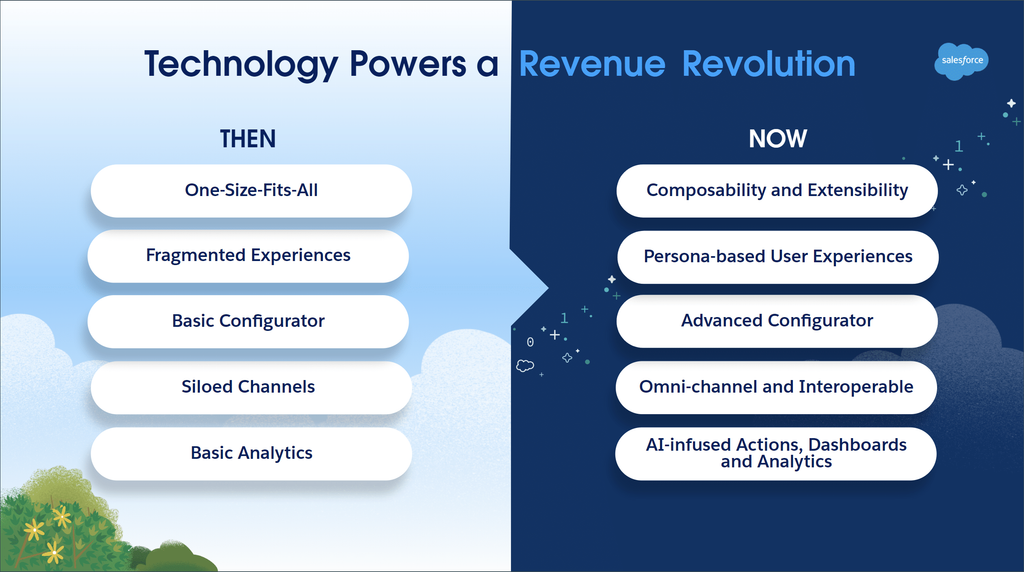
Source: https://admin.salesforce.com/blog/2024/sneak-peek-at-the-revenue-cloud-roadmap
For government contractors, the stakes are higher. Pricing often depends on which contract vehicle a deal runs through, and the same product can carry different prices for commercial and federal buyers. When that logic lives in spreadsheets, errors show up in front of a contracting officer instead of a sales manager.
Core Features of Salesforce Revenue Cloud
Revenue Cloud brings together several connected capabilities that carry a deal from first quote to final invoice.
Product Catalog, Pricing, and Quoting keeps every product, bundle, and price rule in one catalog, then guides reps through configuring and quoting a deal correctly the first time. It won’t let someone build a bundle that doesn’t exist or apply a discount nobody approved, which means fewer quoting mistakes and faster, cleaner proposals.
Contract Lifecycle Management handles contract creation, renewals, and amendments inside the customer’s record, so changes are tracked against the original terms instead of living in someone’s inbox.
Order Management takes over once the deal is signed, giving everyone visibility into fulfillment. Sales and delivery teams work off the same data, so orders stop slipping through the cracks.
Billing & Invoicing turns whatever you sold (one-time purchases, subscriptions, or usage-based charges) into an accurate invoice built from the same data as the quote. It handles proration and connects with tax engines, so finance isn’t rekeying numbers by hand.
Revenue Analytics gives leadership real-time visibility into revenue and pipeline, instead of waiting until month-end to find out what already happened.
Who Revenue Cloud Is For?
Any business with complex pricing is a good fit, but a few industries feel this most.
SaaS companies with subscriptions and usage-based billing rely on automatic renewal tracking. Telecom and manufacturing companies use it to manage complicated, multi-tier pricing across huge product lists.
Government contractors feel this with higher stakes. Under a federal contract, a mismatch between what was quoted and what was billed is a compliance problem as well as a margin problem. And because these systems can hold sensitive government data, many contractors want Revenue Cloud running inside Salesforce Government Cloud alongside the rest of their CRM.
That’s the group we work with most, so the next section looks at what they’re asking for.
What We’re Seeing Government Contractors Ask For
In conversations with government contractors and aerospace and defense suppliers, a consistent set of requests comes up. Most are less about features and more about running a revenue process that holds up under federal rules.
Quoting inside Government Cloud: Teams want quoting to live in the same secure Salesforce Government Cloud environment as the rest of their CRM, often as a clean start rather than a migration of years of legacy data.
Pricing that follows the contract vehicle: Many are replacing spreadsheet-based quoting for GSA Schedules and other contract vehicles, where the same product can carry a different price depending on how it’s bought.
Commercial and government business kept apart: Contractors with both commercial and federal customers want separate sales processes, and some federal subsidiaries need their data kept fully separate from a commercial parent company.
Compliance designed from day one: CMMC Level 2 alignment, administration by U.S. persons only, and keeping Controlled Unclassified Information (CUI) out of quotes and attachments are part of the requirements, not an add-on.
A clean connection to ERP: Pricing, order status, and invoicing often live in an ERP or data warehouse such as NetSuite, and teams want Salesforce and finance working from the same numbers.
Products that aren’t subscriptions: Most Revenue Cloud content leads with SaaS examples, but many contractors sell hardware, parts, and services with only some recurring revenue. The product catalog and pricing rules have to reflect that.
A phased start: Most want core quoting live first, with billing, renewals, and AI capabilities added later, such as using Agentforce to read incoming RFQs and create records automatically.
Revenue Cloud vs. Sales Cloud
Sales Cloud manages the front end of the relationship: leads, opportunities, and pipeline. It’s a great foundation if your pricing is simple and your main need is solid CRM.
Once your business needs governed pricing, contract-specific price lists, bundles, or automated billing, Sales Cloud reaches its limit. Revenue Cloud picks up right where Sales Cloud stops, turning a closed deal into a real contract and a real billing schedule, so sales and finance are working from the same version of the deal instead of reconciling two different ones.
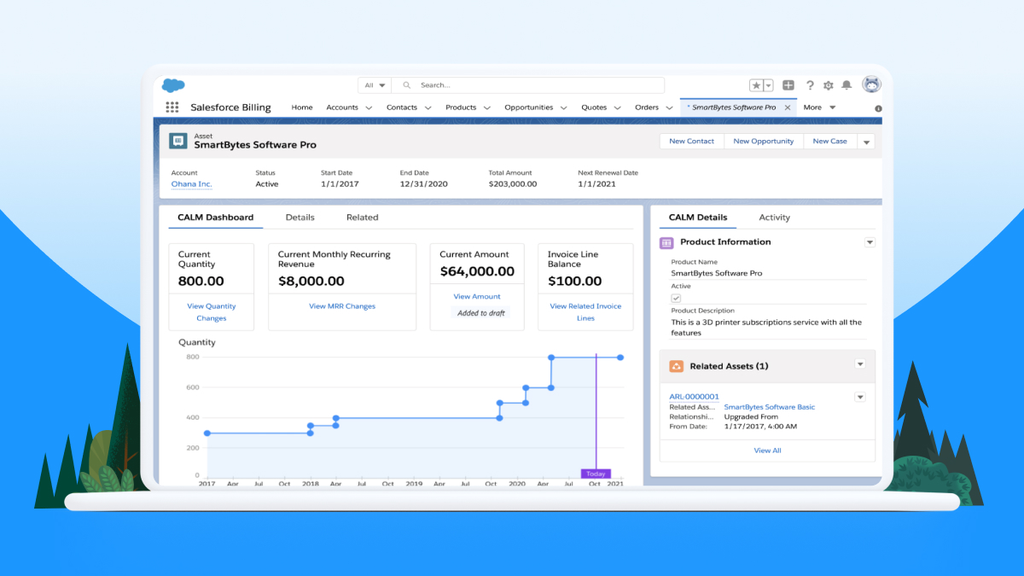
Source: https://www.salesforce.com/news/stories/revenue-cloud-news/
Common Implementation Challenges
Revenue Cloud takes real planning, and a few challenges show up on almost every project.
Messy product and pricing data is usually the first problem. Years of duplicate entries and inconsistent rules will break a new billing system fast if nobody cleans them up first. Connecting to existing finance systems takes careful planning too, or you’ll spend months chasing data that doesn’t line up.
Government contractors have a few more to plan for. Confirm which Revenue Cloud features are available in your Government Cloud environment before you design around them, decide early what data should stay out of Salesforce entirely (such as CUI), and settle who is allowed to administer the system.
Then there’s the human side. Reps who’ve relied on their own spreadsheets for years don’t give them up just because a new system arrives. Skip the change management piece, and you’ll get a system that technically works but that people quietly avoid, which ends up costing more than the software itself.
Best Practices for a Successful Implementation
Clean up your data before you build anything. Automating a mess just gets you a faster mess. Simplify your process first too, rather than building a special rule for every exception your business has ever had.
Bring sales and finance into the planning together, early, so everyone agrees on the pricing and approval rules before go-live instead of arguing about them after. Train your team before launch, not during the first confusing week.
Start with a phase you can finish. Get core quoting live and working, then add billing, renewals, and automation once your team trusts the foundation.
And if you’re weighing this against having one in-house admin figure it out alone, it’s worth knowing how that usually goes. Our guide to Salesforce Managed Services covers why a “Solo Admin” tends to get buried under this kind of complexity.
How Vectr Solutions Helps Organizations Implement Revenue Cloud
Vectr Solutions works with government contractors, aerospace and defense suppliers, and other regulated organizations that need Salesforce to meet compliance requirements as well as sales goals. Our team starts by mapping how you quote, contract, and bill today, then designs a Revenue Cloud solution that fits how your business actually sells, through our Salesforce Implementation Services.
We bring experience delivering in Salesforce Government Cloud, and we design security controls and documentation with your audit requirements in mind. We plan the connection to your ERP or data warehouse up front, and we build change management into the rollout from the start, so your team adopts the new system instead of working around it.
After launch, our Salesforce Managed Services team keeps things running and improving at your pace, without you needing to build a full team in-house.
Modernize Your Revenue Operations with Salesforce Revenue Cloud
Whether you’re replacing spreadsheet quoting, separating commercial and government sales, or connecting quoting to finance, Salesforce Revenue Cloud gives sales and finance one shared source of truth. Vectr Solutions helps government contractors and other regulated organizations design, implement, and support Revenue Cloud around how their business actually runs.