
Digital transformation projects rarely fail because the technology is bad. They fail because the people who are supposed to use it don’t. A Salesforce org can be architected beautifully, tested thoroughly, and still turn into expensive shelfware if end users quietly go back to spreadsheets and email the week after go-live.
The stakes are real. When adoption lags, data quality erodes, reporting becomes guesswork, and the ROI leadership promised the board never shows up. For public sector and enterprise organizations, that’s not just a budget problem. It’s a compliance and mission problem.
At Vectr Solutions, this is a core part of how we deliver. We’ve learned that the technical build is often the easy part. The harder, more valuable work is managing the people side of change: helping real users, in real roles, actually want to use the system on day 100, not just day one.

Read our blog on why the right implementation partner matters.
Understanding Why Adoption Fails
Adoption problems are rarely software problems. Resistance shows up when a new tool conflicts with the way people already do their jobs. If a system asks a caseworker or contracting officer to work against their instincts instead of with them, that system becomes a chore, not a shortcut.
Cluttered interfaces make this worse. Extra tabs, irrelevant fields, and generic layouts pile on cognitive load until users decide the workaround is faster than the “official” tool.
Add in thin training and vague communication, and you get an organization full of people who were told what changed but never shown why it helps them personally. Confidence drops fast after go-live, and it rarely recovers on its own.
Building the Foundation: Leadership and Stakeholder Alignment
Adoption is won or lost before a single screen is configured. Executive sponsorship has to be visible and active: leaders who actually use their own dashboards in staff meetings send a stronger signal than any kickoff email ever will.
This is also where stakeholder analysis earns its keep. Understanding each group’s daily workflow, pain points, and pressure points lets a project team design around real jobs instead of assumed ones.
We run this as a formal step in our own methodology, using stakeholder interviews, executive visioning sessions, and an impact index assessment to figure out exactly who is affected and how, before we ever touch configuration. Pair that with clear, measurable adoption goals set up front, and the whole project has something concrete to steer toward.
Effective Training and Education Programs
Generic click-through demos don’t build confidence. Role-based, scenario-driven training does, especially when it happens in a sandbox where people can make mistakes without consequences.
Training also can’t be a one-time event bolted onto the end of a project. In-app guidance, refresher sessions, and quick reference guides keep skills current as the platform evolves.
One of the most effective levers we use with clients is a Champion Network: identifying “super users” in each department early, giving them deeper training, and letting them become the first line of support their peers actually trust. Peer coaching tends to beat a help desk ticket every time.

Communication and Engagement Strategy
People don’t resist change so much as they resist surprise. Clear, consistent messaging about what’s changing, why, and what it means for someone’s actual day-to-day work goes a long way toward disarming resistance before it starts.
Communication has to run both directions. Pulse surveys, user steering committees, and listening sessions give leadership a read on where friction is building, and acting on that feedback tells users their input matters.
Small wins deserve airtime too. Publicizing an early success, a department that adopted quickly or cut processing time, gives the rest of the organization proof the change is worth the effort, not just a mandate to comply with.
Simplify the User Experience
A cluttered org is an adoption killer in disguise. Removing unnecessary fields, consolidating tabs, and building role-specific layouts cuts the noise so people can get through their actual work instead of hunting for the right screen.
Guided walkthroughs, pre-built dashboards, and automated data entry compound that effect. Every manual step you remove is one less reason for someone to open a spreadsheet instead of Salesforce. Usability isn’t a nice-to-have here. It’s one of the fastest, most direct levers for adoption available to a project team.
Pilot Programs, Phased Rollouts, and Testing
Rolling out to everyone at once is a good way to discover every problem at maximum volume. Starting with a pilot group, a smaller department or a defined subset of users, lets a team validate workflows, gather feedback, and fix what’s broken before it’s everyone’s problem.
User Acceptance Testing matters here too, not as a checkbox but as a real chance for end users to confirm the system matches how they actually work. We build this into our delivery model directly, with sprint demos and UAT cycles running alongside training, so issues surface in weeks, not months after launch.
Monitoring, Metrics, and Continuous Improvement
Adoption doesn’t end at go-live. It has to be measured. Login frequency, feature usage, data completeness, and process compliance all tell you whether people are actually living in the system or just logging in to check a box.
Custom adoption dashboards give leaders and project teams a live read on where usage is strong and where it’s lagging, so support can go where it’s needed instead of everywhere at once.

This is also where reinforcement lives: drip communications, refresher training, and updated FAQs targeted at the specific areas where confusion shows up. Adoption is a discipline, not a milestone.
Change Management Risks and Mitigation
The common failure modes are predictable: passive resistance, scope creep, weak executive backing, and training that got cut when the budget got tight. None of these are exotic. All of them are avoidable with early planning.
Mitigation looks like what’s already been described: engage stakeholders early, plan role-by-role rather than department-wide, build in buffer time for the inevitable surprises, and don’t skip the pilot phase to save two weeks on the schedule.
The organizations that build this discipline up front spend far less time explaining delays later. If you want the fuller picture of what these risks actually cost in dollars and lost productivity, we broke that down in The Cost of NOT Having a Change Management Approach to Your Salesforce Implementation.
How Vectr Solutions Supports Successful Adoption
We apply the Prosci™ methodology and the ADKAR® framework across a structured three-phase process: Assess and Prepare, Manage Change, and Reinforce Adoption and Sustain Outcomes. Our Salesforce-certified Change Managers build that framework into stakeholder planning, role-based training, communication strategy, and post-launch reinforcement on our enterprise Salesforce projects.
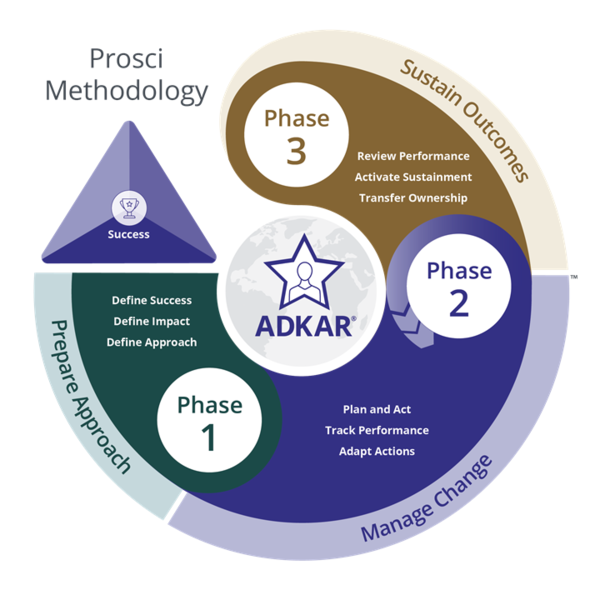
Source: https://www.prosci.com/blog/the-importance-of-integrating-individual-and-organizational-change
We’ve seen this play out in practice. When we worked with Armis, a cybersecurity company, to move their help desk and call center onto Salesforce Government Cloud, their team needed customer support to keep running the whole time. When compliance requirements meant some existing features couldn’t move over, we delivered business process alternatives so their team still had a clear way to work, along with a more user-friendly customer service portal.
Across more than 60 Salesforce implementations, this is the pattern we keep proving out: the technical build gets you to go-live, but the people-side plan is what makes the platform stick.
Conclusion
Leadership sponsorship, role-based training, a clean user experience, honest feedback loops, and real metrics: these are the levers that separate a Salesforce investment that pays off from one that quietly gathers dust. None of them are complicated on their own. What’s hard is doing all of them, consistently, from kickoff through the months after go-live.
Ready to transform user adoption into measurable success? Let Vectr Solutions help guide your Salesforce change management strategy. Get in touch with our team today!