
Modern public sector organizations frequently struggle with fragmented data, isolated legacy technology, and complex security barriers. Historically, these structural silos forced departments into manual, slow coordination or expensive custom-coded integrations that broke the moment one agency touched its own system. As autonomous agents start doing real work instead of just answering questions, that old model no longer keeps up. A decentralized approach to digital collaboration is now what constituents expect and what operational speed requires.
Agent-to-agent architecture is the answer, and it’s a familiar kind of answer: standards-based, security-first, and built to meet federal and state compliance requirements.

By letting specialized AI agents communicate, share context, and delegate tasks directly across organizational lines, public networks can automate complex workflows without loosening their grip on data governance. Systems of record stay in place. A2A gives them a way to talk to each other without a six-month integration project every time.
What Is Agent-to-Agent Architecture?
Agent-to-agent (A2A) architecture is a collaborative framework that lets independent AI agents, built on different platforms or by different teams, securely interact and complete multi-step tasks over a network. Traditional software integration relies on rigid, pre-defined rules written by a human who had to anticipate every scenario in advance. A2A flips that. Agents negotiate and discover each other at runtime, working as specialized digital peers that hand off tasks based on what’s actually happening, not what a requirements document guessed might happen two years ago.
The open Agent2Agent protocol, governed by the Linux Foundation, standardizes this using JSON-RPC over HTTP and Server-Sent Events. It operates alongside, not instead of, the Model Context Protocol (MCP), which governs how an individual agent accesses its own local tools and databases.
Think of MCP as how an agent reaches its own tools and data, and A2A as how it talks to the agency next door. A vertical MCP tool call is typically a short, contained request. A horizontal A2A delegation might span independent networks, run for hours, or pause mid-task waiting on a human’s sign-off, all while holding state server-side against a task ID instead of a local call stack. That distinction matters more in government than almost anywhere else, because it means agencies can build resilient, long-running workflows without ever handing a stranger the keys to their internal systems.
Why Multi-Agency Environments Pose Additional Challenges
Deploying AI across public sector systems introduces governance friction that doesn’t show up in a typical enterprise rollout. Every department operates under its own statutory mandates for handling PII and Controlled Unclassified Information, which makes direct cross-agency database access a legal barrier as well as a technical one.

Layer on top of that the reality that legacy tech stacks vary wildly by jurisdiction. Forcing every agency onto identical tooling rarely fits the budget, and trying to do it anyway tends to create uncoordinated deployments and compliance debt that compounds over time.
Then there’s trust. Agencies have to treat each other’s systems as opaque. Nobody gets to inspect another organization’s internal logic just because they’re on the same task. Without a standardized validation layer, agents end up exchanging irrelevant data or stalling out entirely, and the constituent on the other end is the one who feels it.
Core Components for Agent-to-Agent Systems in Multi-Agency Contexts
A working multi-agency agentic system relies on a few core components:
Agent Card: This is a self-describing JSON manifest, published at a standard well-known URL, that acts like a digital resume: identity, skills, and authentication rules, all upfront.
Tasks: Once an agent is located, the task becomes the unit of work, a stateful object with a unique ID that tracks progress across long-running processes.
Human approval: If a task needs human sign-off, the system moves to an “input required” state and waits, rather than failing and forcing a restart.
Messages & artifacts: Communication itself runs through structured message blocks and artifacts, so a remote agent gets exactly the information it needs to do its job and nothing more. Each agency’s internal memory, rules, and database connections stay private the entire time.
Salesforce Agentforce & Related Technologies That Support Agent-to-Agent Architecture
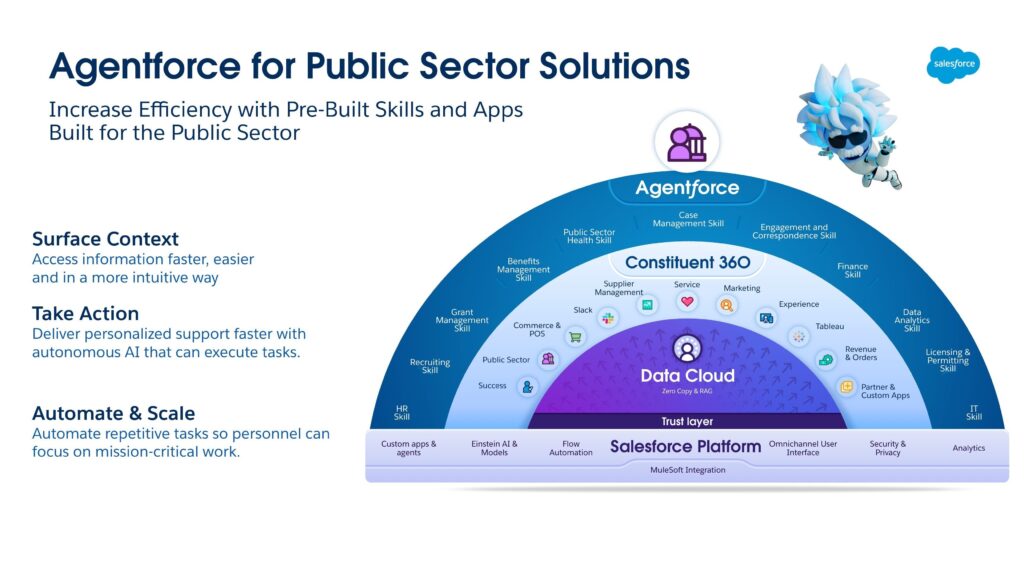
Enterprise platforms give agencies the foundational layer to build this without starting from scratch. Salesforce Agentforce, powered by the Atlas Reasoning Engine, shifts the CRM from passive record-keeping to a system that actually plans and executes multi-step work inside defined guardrails.
Source: https://www.salesforce.com/government/guided-tours/agentforce/
For orchestrating agents across a multi-agency network, we design architectures around Agent-to-Agent (A2A) and Model Context Protocol (MCP) standards, implemented through MuleSoft for secure, compliant integration. Architects can define an entire agent network declaratively, which decouples how the network is designed from how it runs. That separation is what allows interoperability between Salesforce and the agents and platforms an individual agency already has running.
On the data side, Salesforce Data 360 uses a zero-copy architecture so agents can ground their reasoning in live, unified profiles without duplicating sensitive records across every system that touches them. Automated logging closes the loop, keeping every agent decision observable and auditable which, in public sector work, is the difference between a defensible system and a liability.
Security, Trust, and Governance Considerations
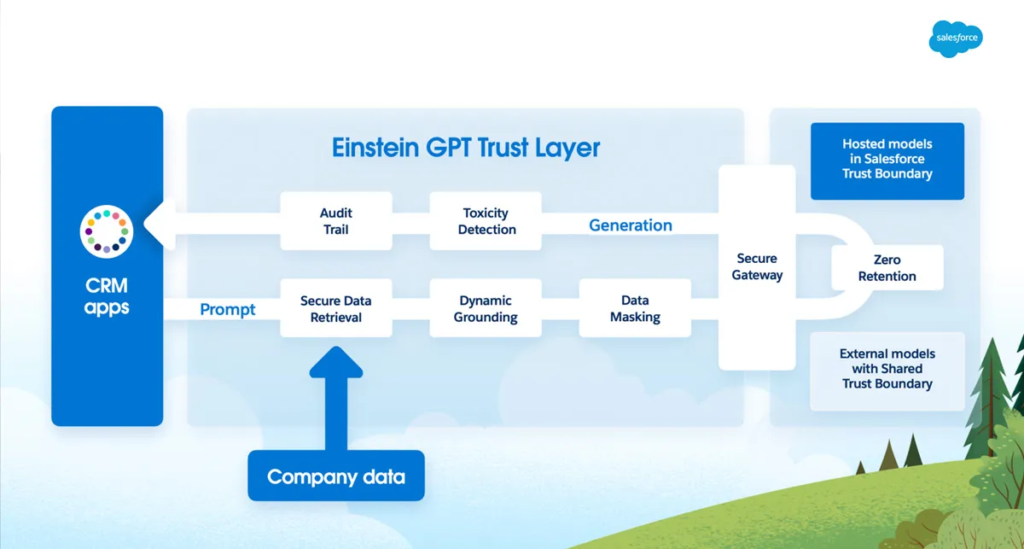
Trust starts with verifying identity. Secure API gateways, role-based access controls, and JSON Web Signatures confirm an Agent Card is legitimate before any transaction starts. Inside Salesforce specifically, the Einstein Trust Layer handles prompt defense, toxicity screening, and automatic data masking so sensitive fields never reach a model that isn’t authorized to see them. It does this with zero data retention from third-party model providers, so nothing sensitive lingers after the request is done.
Source: https://www.salesforce.com/news/stories/video/explaining-the-einstein-gpt-trust-layer/
Governance here runs on a shared responsibility model. Platform teams configure the access boundaries; every transaction generates an immutable audit trail that supports the frameworks agencies are already accountable to, such as NIST 800-53 and FedRAMP. Treat these controls as ongoing documentation that belongs in your SSP, your change control process, and your next audit.
Deployment Models and Best Practices in Multi-Agency Settings
There’s no single right topology. A federated model lets each agency keep its own platform and communicate only through standardized handoffs, the model that matches the political reality of most public sector networks, where nobody’s giving up their system of record.
A centralized model runs everything in one shared environment, which is simpler but rarely works with agency autonomy requirements.
A hybrid model splits the difference: agencies keep private platforms but route tasks through centralized registries and brokers.
Whichever model an agency lands on, the best practices don’t change: clear data contracts between agencies, defined SLAs, specification-first configuration so one agency’s internal update doesn’t silently break another’s workflow, and change management that treats the human side of the rollout as seriously as the architecture.
Use Case: Unifying Three Systems Into One
Agent-to-agent builds on integration work agencies can do today. We recently worked with three of the U.S. Service Academies, where applicants have to clear two separate processes: admissions and a formal nomination from an authorized nominating source, whether that’s a Member of Congress, a Service Secretary, or another non-congressional authority. Each academy had run its own disconnected system, which meant duplicate logins and conflicting records for congressional offices trying to track a nomination across institutions.

We built the integration layer for a centralized Nominations Portal, using MuleSoft to create a bidirectional data exchange hub connecting all three academies and unifying login across the ecosystem.
The result: overlap and data conflicts disappeared, congressional staff got one system to learn instead of three, and academy stakeholders came away with the MuleSoft knowledge and best practices to keep the integration healthy long-term. It’s the same underlying challenge agent-to-agent architecture is built to solve at a larger scale: disparate systems that need to trust and talk to each other. Here, MuleSoft handled the exchange. In an A2A model, agents would negotiate those handoffs directly.
Other scenarios follow the same pattern: a housing agent checking eligibility with a state benefits agent and exchanging only a masked decision artifact; a dispatch agent coordinating with transportation systems during an emergency to adjust signals or close routes in real time; a tax agent triggering a clean handoff to a new municipality’s registration system when a resident moves, instead of making them fill out the same form twice.
Performance, Monitoring & Scaling
Architects need visibility into latency, task failure rates, and message throughput, especially for long-running workflows that pause on human approval. Tools like the MuleSoft Agent Visualizer turn what would otherwise be an unobservable black box into a real topology map, surfacing bottlenecks and drift before they become incidents. Event-driven, stream-based triggers should be the default over database polling. The difference matters when the traffic spike is a statewide emergency alert and not a quarterly report.
Risks, Trade-Offs & Mitigations
Multi-agency governance carries real overhead, and skipping it usually moves the cost to later, often in the form of an incident report. Security concerns and model drift add complexity on top of that. The best mitigation is a phased rollout: sandbox testing, limited pilots, and independent evaluation at the API boundary to catch regressions in groundedness and output quality before they touch a live workflow.
How Vectr Solutions Helps
Vectr Solutions works with agencies through AI Readiness Assessment & Blueprinting to map workflows, compliance needs, and pain points before anything gets built, then designs the agent registries, metadata schemas, and secure protocols that make cross-agency interactions structured, policy-governed, and fully auditable. From there, our team supports implementation of platforms like Agentforce and MuleSoft Agent Fabric, backed by the same Salesforce Advisory & Governance and Change Management practices we bring to every public sector engagement, because the technology only works if the people using it trust it.
Conclusion
Standardized agent-to-agent architectures are how multi-agency collaboration stops being a manual, case-by-case negotiation and starts being an actual system. By bridging data silos and automating complex workflows without compromising governance, agencies can deliver the modern, connected experience constituents expect while keeping every agency’s sovereignty intact.
The agencies that start architectural planning now will be the ones setting the standard later, not the ones scrambling to retrofit it.
Interested in building secure, scalable agent-to-agent architectures across agencies? Let Vectr Solutions guide you through design, governance, and implementation.