
In the early lifecycle of a business, Salesforce feels like a superpower. It is a tool that brings instant order to the chaos of growth. But as we move through the second half of 2026, many organizations are hitting the Maintenance Trap. These companies are spending 90% of their time firefighting legacy workflows instead of driving innovation.
The reality is that most enterprises are not constrained by ideas. They are constrained by the accumulation of technical debt inside Salesforce and the surrounding ecosystem.
At Vectr Solutions, we recognize that the digital landscape has fundamentally shifted. We have moved past the era of the ‘system of record’ and into the Agentic Enterprise. This evolution transforms CRM from a passive repository into an active execution layer for your business. The mistake we see most often is treating AI as a superficial add-on rather than redesigning the core systems it needs to inhabit.
AI Agents & The Atlas Reasoning Engine
The defining innovation for 2026 is Agentforce, the unified platform representing the next phase of Salesforce’s AI evolution. While many tools in the market are positioned as chatbots, Agentforce is better understood as digital labor. These are agents that can reason, take action, and operate autonomously inside the Customer 360 ecosystem.
At the core is the Atlas Reasoning Engine. Unlike traditional bots that rely on rigid if-then logic, Atlas uses a ReAct (Reasoning and Acting) loop. It breaks down goals into steps, evaluates outcomes, and determines next actions based on real-time context.
It is important we highlight the distinction though that reliability is not a product of the model. It is a product of the architecture. Agents only perform as well as the structure they are deployed into. Without clean process definitions, AI doesn’t create intelligence. It simply amplifies inconsistency.
Data 360: The Foundation of the Agentic Enterprise
An AI agent is only as effective as the data it can access. Salesforce’s evolution toward Data 360 reflects a major attempt to address the fragmentation problem.
One of the most important shifts is the Zero Copy approach. Instead of duplicating data through traditional ETL pipelines, organizations can access data where it lives across platforms like Snowflake, AWS, and BigQuery. While this reduces engineering overhead, it exposes a hard truth. If your data is not clean at the source, Zero Copy simply reveals your problems faster.
For agentic systems, a unified data layer is non-negotiable. By specializing in harmonizing these data streams to ensure that when an agent “reasons,” it is doing so against a single source of truth.
Hyperautomation & Flow Orchestration
Salesforce Flow is now the center of enterprise automation. Legacy tools like Workflow Rules and Process Builder have reached their final retirement path.
This is forcing a broader reckoning. Maintaining “zombie logic” is no longer neutral. This refers to years of embedded code that was never designed for scale. It is now a risk factor for security and delivery speed. When combined with MuleSoft, Flow becomes a true orchestration layer. A “Closed Won” opportunity in Salesforce can now trigger downstream fulfillment in SAP, update Workday, and initiate compliance workflows without human intervention.
Vertical Clouds & Industry-Focused Solutions
Salesforce is doubling down on industry-specific clouds to accelerate ‘speed to value.’ We focus our architectural expertise on these mission-critical environments where precision is non-negotiable:
Healthcare: Using Agentforce to automate clinical record summarization and patient scheduling, reducing employee burnout and accelerating time to care.
Financial Services: Financial Services Cloud (FSC) now includes Agentforce actions, delivering faster, smarter support for banking and collections inquiries at scale.
Public Sector & Defense: Through the Missionforce initiative, we are modernizing agency operations. Our implementations of the Licensing & Permitting consoles centralize constituent data. This allows clerks to approve applications from a single screen rather than navigating legacy silos.% of their prepaid limit, triggering a task for the Account Manager or an automated email to the client.
Security, Privacy & The Trust Layer
As CRM platforms manage increasingly sensitive intelligence, the Einstein Trust Layer is the ultimate differentiator. It ensures that while agents reason over your data, that data is never retained by third-party LLM providers.
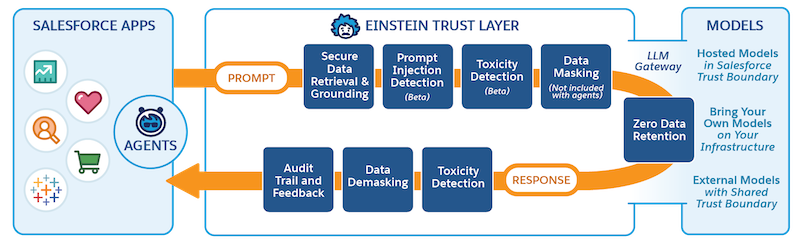
Source: Einstein Trust Layer: Designed for Trust
Furthermore, the trend toward Citizen Development is now a formal enterprise strategy. Tools like Agentforce Canvas empower business analysts to build custom agents using natural language prompts.
Innovation without oversight is a liability. This is why our methodology centers on rigorous governance. To prevent the rise of ‘rogue agents,’ we utilize the Einstein Trust Layer and Agentforce Guardrails to audit agent actions and enforce the Principle of Least Privilege. In highly regulated industries, this level of control isn’t just a best practice; it is a requirement for scale.
Low-Code Platforms & Developer Empowerment
The trend toward Citizen Development has evolved into a core enterprise strategy. Industry analysts like Gartner predict that by the end of 2026, 80% of technology products will be built by professionals working outside of traditional IT departments.
Tools like Agentforce Studio empower business analysts to “vibe-build” custom AI agents using natural language prompts. This replaces the old cycle of waiting weeks for custom Apex code. It is why Vectr Solutions is prioritizing the governance of these tools above all else.
To prevent the rise of “rogue agents,” we implement Salesforce Shield and Agentforce Guardrails. This solution uses AI to audit connected apps and enforce the Principle of Least Privilege. This remains a cornerstone of our approach, particularly for our clients in highly regulated industries.
Preparing Your Organization for the Future
To future-proof your stack for the rest of 2026, Vectr Solutions recommends a three-pillar roadmap:
- Composable Architecture: Move away from monolithic IT toward modular designs that allow you to “plug and play” new AI agents without breaking the foundation.
- Outcome-Based ROI: Give every AI agent a “job description” tied to a specific business goal—such as revenue predictability or service responsiveness.
- Proactive Technical Debt Migration: Do not wait for the next release to address legacy workflows. The longer you wait, the harder the “Technical Debt Reckoning” becomes.
Conclusion
The evolution of Salesforce for the remainder of 2026 is defined by the rise of the Agentic Enterprise—a workplace where humans and AI agents work together to drive growth. By embracing autonomous agents, unified data through Data 360, and a modular architecture, your organization can finally move from “survival mode” to “strategy mode.”
Want to future-proof your Salesforce stack? Talk to Vectr Solutions about designing for innovation and staying ahead of trends.