

For years, organizations evaluating MuleSoft viewed the platform through a relatively narrow lens: integration. The conversation typically centered around connecting Salesforce to ERP systems, exposing legacy applications through APIs, replacing point-to-point integrations, or modernizing middleware. While those use cases remain important, they no longer fully capture MuleSoft’s evolving role within the Salesforce ecosystem.
We are seeing a significant shift in how enterprise architects, technology leaders, and business stakeholders evaluate the platform. As Salesforce continues investing in Agentforce, Data 360, Flow orchestration, autonomous agents, and AI-powered experiences, MuleSoft is increasingly becoming the foundation that allows these technologies to interact with the broader enterprise.
The question is no longer whether an organization needs another integration platform. Increasingly, organizations are asking whether they have established an agent-ready foundation capable of exposing business capabilities consistently across applications, workflows, data platforms, partners, and AI systems. In many cases, the challenge is now governance, orchestration, and the ability to operationalize enterprise capabilities at scale.
The Rise of the Agent Fabric
One of the most important architectural shifts occurring today is the emergence of the Agent Fabric.
Rather than treating integrations as isolated connections between systems, organizations are creating a reusable layer of APIs, workflows, data services, and enterprise actions that can be consumed across the business. In this model, MuleSoft becomes more than an integration platform. It becomes the connective tissue between systems, applications, workflows, data sources, and AI agents.
The Agent Fabric creates a governed framework that allows organizations to expose business capabilities as reusable services, orchestrate workflows across multiple platforms, securely connect trusted data sources, and enable interoperability across organizational boundaries. Most importantly, it allows organizations to scale AI initiatives without continuously rebuilding integrations for every new use case.
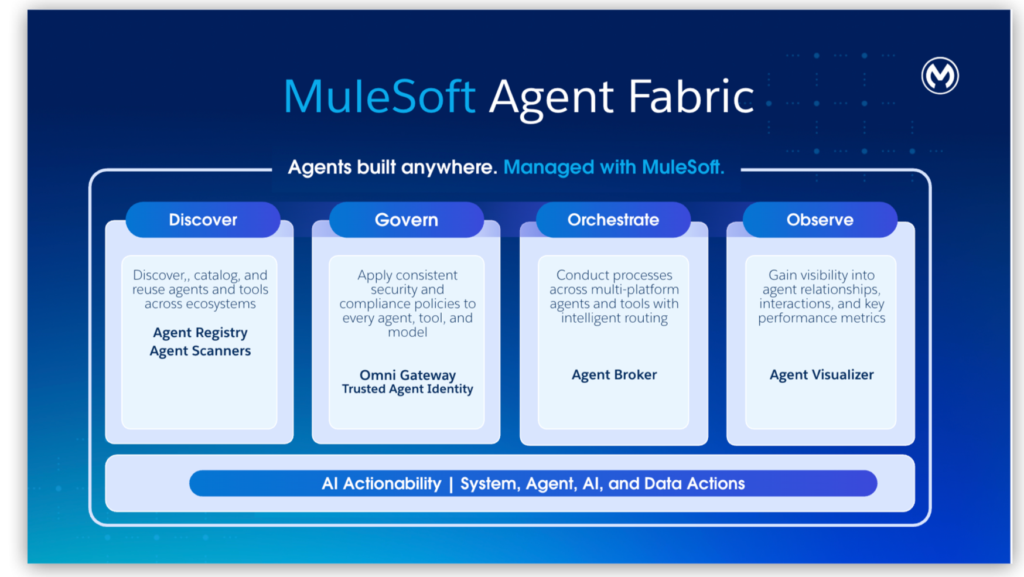
Source: https://docs.mulesoft.com/general/agent-fabric-overview
As organizations deploy more autonomous capabilities, this foundation becomes increasingly important. The future enterprise will not consist of a single application or a single AI model. It will consist of hundreds of connected capabilities operating across multiple systems, environments, and trust boundaries.
Organizations that establish this foundation today will be significantly better positioned to support future agent-driven initiatives tomorrow.
Why Agent Fabric Matters
Today’s rapid AI adoption is exposing a challenge many organizations already have: AI systems cannot create value unless they can execute real business actions.
An agent may need to retrieve customer information, create a service request, initiate an approval workflow, validate inventory, or update a record. Those actions do not occur inside an LLM. They occur inside enterprise systems.
This is where MuleSoft’s API-led connectivity becomes highly strategic. By exposing business capabilities as reusable services, organizations transform traditional integrations into enterprise actions that can be securely accessed, governed, monitored, and reused across multiple channels.
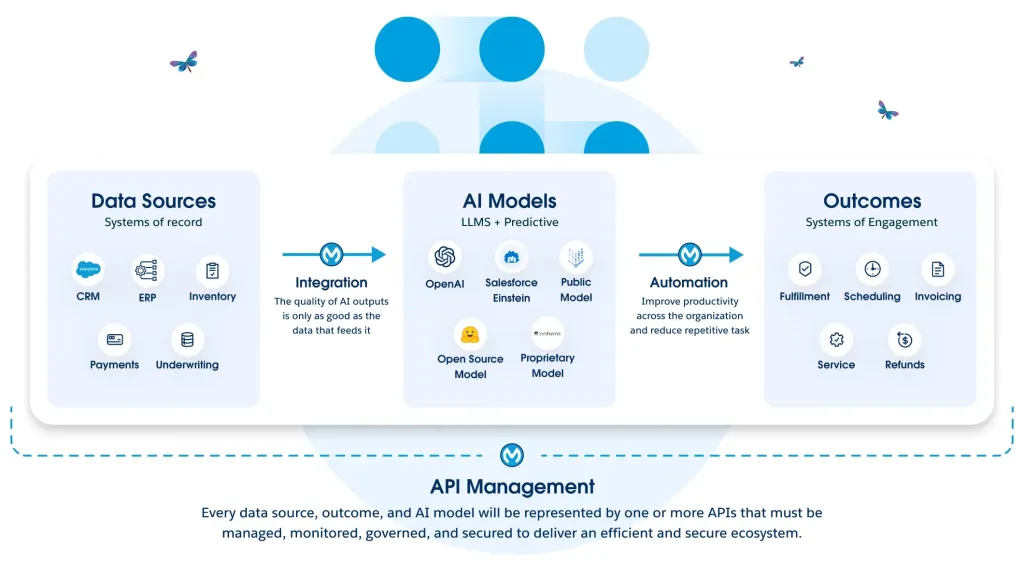
Source: https://www.salesforce.com/mulesoft/
Whether supporting a service portal, workflow automation, analytics platform, or Agentforce implementation, the same reusable capabilities can power every experience without requiring separate integrations.
Governance and Enterprise Scale
The growing importance of Agent Fabric explains why MuleSoft now sits at the center of many Salesforce architecture conversations.
Initiatives such as Agentforce, Data 360 activation, and Flow orchestration all depend on a governed mechanism for exposing business capabilities beyond the boundaries of a single application. Historical investments in API-led connectivity become significantly more valuable when those same capabilities can be reused across AI, automation, analytics, and customer experiences.
This becomes especially important in regulated environments where organizations operate across multiple Salesforce orgs, Government Cloud environments, and legacy systems. As autonomous capabilities expand, requirements around governance, identity, compliance, auditability, and data residency become increasingly critical.
A well-governed Agent Fabric provides the framework needed to support these requirements while enabling innovation at scale.
Conclusion
At Vectr Solutions, we believe the most important shift happening within the MuleSoft ecosystem is not a single AI feature or integration capability. It is Salesforce’s broader vision for enabling enterprise agent action.
MuleSoft is evolving from an integration platform into the foundation for governed, reusable business capabilities that can be consumed by applications, workflows, and AI agents alike. As organizations adopt Agentforce and other AI-powered experiences, success will increasingly depend on their ability to expose trusted enterprise actions at scale.
That is why Agent Fabric is emerging as a foundational architectural pattern for the future of enterprise AI.