
To the average citizen, “the government” is one thing. They don’t know or care that renewing a business license, applying for benefits, or reporting a public safety concern touches three different agencies, two different jurisdictions, and at least one mainframe old enough to collect Social Security itself. They just want it to work.
Behind the scenes, it rarely does. Agencies operate as islands of excellence with each one great at its own job, terrible at talking to the island next door. The result is a citizen who becomes the unofficial “integration layer,” re-entering the same address and the same documents into three different portals because the systems won’t do it for them.

Fixing that isn’t a nice-to-have anymore. It’s the whole ballgame.
Why Cross-Government Collaboration Is So Hard
The federal government spends over $100 billion a year on IT, and roughly 80% of it goes to keeping legacy systems alive rather than moving them forward. That’s not a typo. That’s four out of every five dollars spent defending the status quo. These decades-old systems create what we’d call “information gravity”: data stays exactly where it was born, because moving it is expensive, risky, and nobody wants to be the one who breaks the mainframe that’s been running since the Clinton administration.
And the disconnection is measurable. Across sectors, MuleSoft’s Connectivity Benchmark finds organizations now run over 1,000 applications on average, yet fewer than a third are actually integrated and 90% of IT leaders say the resulting data silos are actively creating business problems. The government didn’t invent this problem, but with its funding silos and legacy footprint, it lives at the sharp end of it.
Layer funding silos and policy restrictions on top of that, and you get a landscape where every agency is optimized for itself and nobody is optimized for the citizen.
The instinct is to rip everything out and start over. We’d push back on that. Legacy systems aren’t the enemy but assets sitting under a pile of technical debt. Wrapping a mainframe in modern APIs lets data flow into a unified environment without touching the plumbing underneath. Build the bridge before you retire the old road. Continuity of service now, evolution on a realistic timeline.
Salesforce as a Shared Platform for Government
This is where Salesforce earns its keep as connective tissue rather than just another system to maintain. A single, low-code, compliance-enabled platform lets agencies step off the legacy treadmill and stop re-integrating the same data over and over. The value isn’t a shinier database, it’s that a record entered once becomes visible everywhere it’s authorized to be.
With Salesforce Public Sector Solutions, agencies can pull together data from wherever it lives like federal tax records, state health exchanges, or local housing databases, and act on it in real time, without flattening the autonomy each agency is (rightfully) protective of. It’s less “one system to rule them all” and more “one shared language everyone can finally speak.”
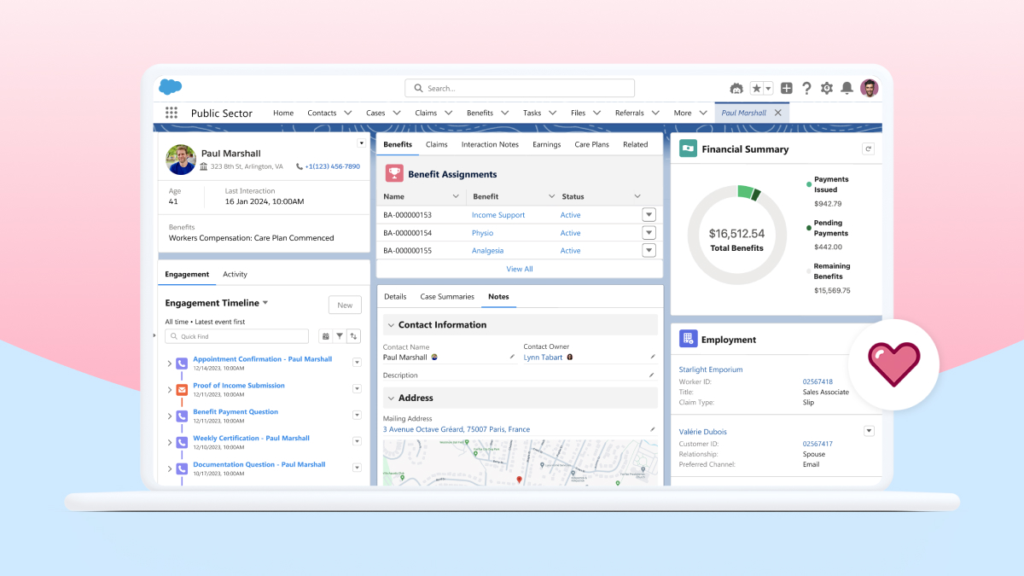
Source: https://www.salesforce.com/news/stories/ai-feature-news-public-sector/
Key Use Cases for Cross-Agency Coordination
The value shows up fastest in public safety and benefits administration, where the cost of disconnected systems is measured in missed cases and frustrated caseworkers, not just IT tickets.
In public safety, neighboring jurisdictions often manage overlapping offender populations. Cross-agency data sharing turns a patchwork of local pictures into an accurate regional one, helping investigators spot priority patterns instead of rediscovering the same information three times.
In benefits management, a citizen’s “change of circumstance” like losing a job, for instance, often makes them eligible for multiple programs at once. When intake and recertification run on a single connected platform instead of separate program systems, agencies have seen worker efficiency on administrative work improve by roughly 20%, freeing staff to actually work cases instead of chasing paperwork.
We saw a version of this challenge play out with the U.S. Service Academies, where prospective applicants had to navigate separate nomination and admissions processes across three completely different systems. Vectr Solutions built the integration layer for a centralized Nominations Portal, unifying login and data exchange across all three academies. Congressional offices and institutional staff stopped managing three sets of conflicting data and started working from one accurate picture and the academies picked up the MuleSoft integration knowledge to keep the system healthy long after we walked away.
Data Sharing Without Losing Control
Every conversation about connectivity eventually runs into the same wall: nobody wants to be the agency that leaked FCI, PII, or CUI because a well-meaning integration didn’t respect a boundary. That fear is legitimate. “Spillage” isn’t a rounding error in the government, it’s a headline.
This is why the environment matters as much as the use case. Salesforce Government Cloud Plus is built to meet FedRAMP High and DoD Impact Level 2, with Impact Levels 4 and 5 available through Government Cloud Plus – Defense, keeping sensitive data isolated from commercial traffic. Salesforce Private Connect adds another layer, routing traffic through secure internal connections rather than the open internet. Think of it as an HOV lane for government data, moving fast without mixing with everyone else’s traffic.
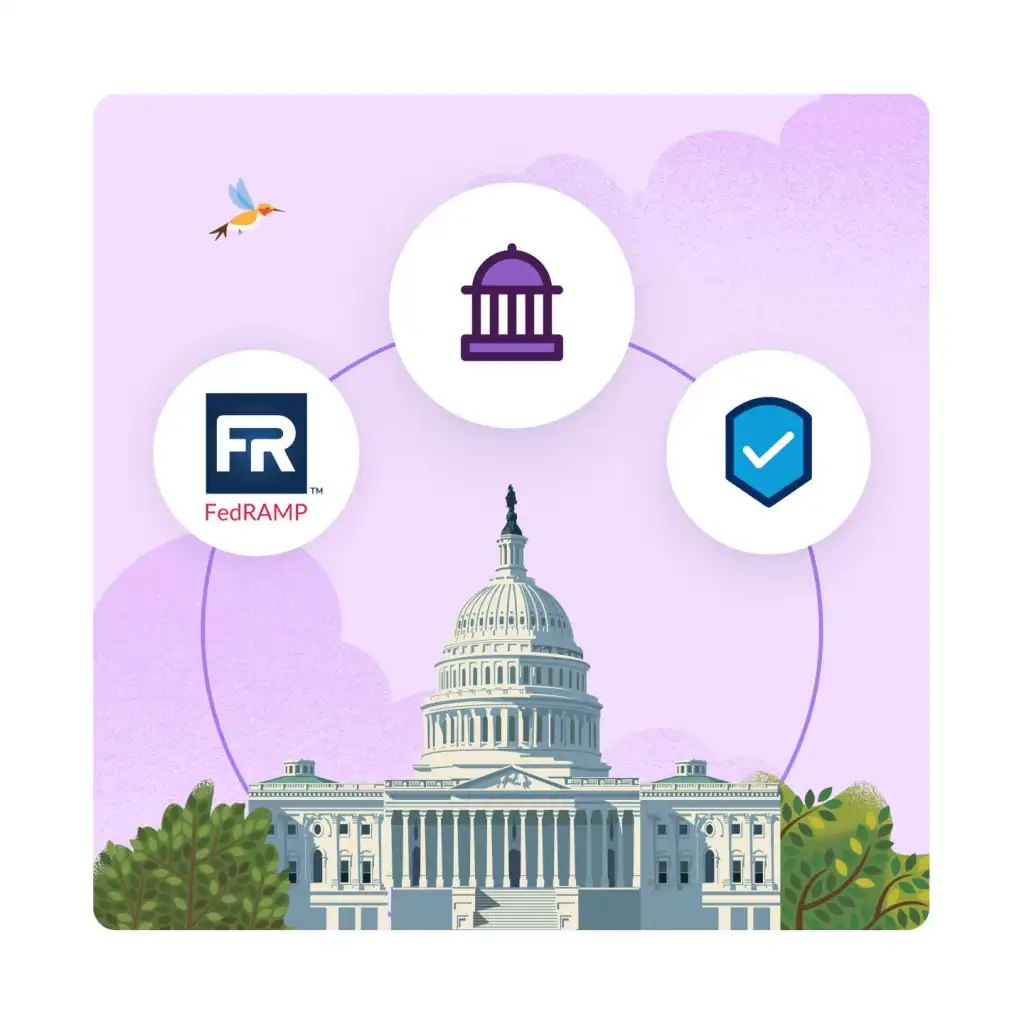
Source: https://www.salesforce.com/government/cloud/
We put that same rigor to work standing up a secure, FedRAMP-ready Salesforce Government Cloud environment for a defense technology organization supporting the Department of Defense, complete with MFA, record-level access controls, and a branded self-service portal for military sponsors that’s delivered in 10 weeks, not 10 months.
The Role of Integration, APIs, and Automation
Historically, agencies solved connectivity with point-to-point integrations: custom code linking System A directly to System B. It works fine until you have ten systems, at which point you have a spaghetti bowl of fragile dependencies where changing one thing quietly breaks three others. It’s also expensive, organizations spend an average of $4.7 million building and maintaining custom integrations, most of it on wiring that has to be rebuilt every time a system changes.
API-led connectivity through the MuleSoft Anypoint Platform is the modern alternative. Every system becomes an “API product” that other systems can plug into, rather than a one-off wiring job. This approach isn’t theoretical, it’s how agencies stitched together disparate healthcare data during COVID-19 and delivered test results to millions of people in about two weeks. The skill isn’t building custom code for everything; it’s knowing exactly when custom code is worth it and when a standard API pattern will serve the mission just as well, with a lot less maintenance down the road.
Governance Models That Actually Work
The moment agencies start sharing data, someone asks the inevitable question: who owns it now? Fully centralized governance creates consistency but grinds everything to a bureaucratic halt. Fully decentralized governance moves fast but rebuilds the silos you were trying to escape.
The workable middle ground is a Federated Governance Model, a central body sets the guardrails (security protocols, compliance mandates), while individual agencies keep the autonomy to run their own workflows inside those lines. It’s the difference between a state agency innovating locally while still meeting federal standards, versus everyone building their own version of the same wheel and calling it “custom chaos.”
How Vectr Supports Multi-Level Government Implementations
Technology is maybe 20% of a project like this. The other 80% is getting people to actually use it, which is why change management isn’t an afterthought for us. We lean on the Prosci 3-Phase Process to manage the human side of the transition, because a beautifully architected platform that nobody adopts is just an expensive dashboard nobody looks at.
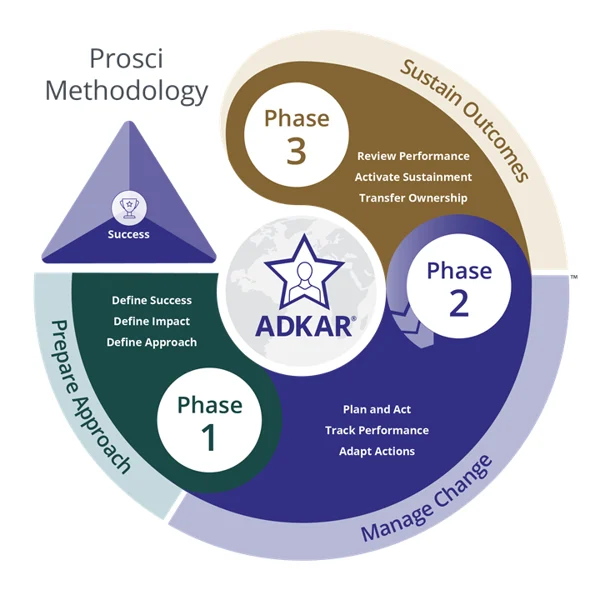
Source: https://www.prosci.com/blog/prosci-methodology
We work with organizations like BioMADE, MindPoint Group, and the Tennessee Wildlife Resources Agency across exactly this kind of multi-level complexity: architecture, federated governance, and delivery that respects both the mission and the compliance envelope it operates in. Increasingly, that also means helping agencies stand up Agentforce for Public Sector to handle high-friction tasks: guiding grant applicants through complex submissions, parsing regulatory text for relevant clauses, and connecting context across citizen service intake so support doesn’t stop at 5 p.m.
Delivering Better Outcomes Through Connected Government
None of this is about chasing a shinier system for its own sake. It’s about making sure a citizen who qualifies for three programs only has to say so once and that the agencies behind the scenes can actually see each other, without pretending the jurisdictional lines don’t exist. The islands-of-excellence model got the government this far. Connective tissue is what gets it the rest of the way.
Looking to improve cross-agency coordination? Vectr helps public sector organizations design connected, secure Salesforce environments. Talk to our team.