
This September will mark Vectr Solutions‘ fourth year at Dreamforce, and I’ll be heading back to San Francisco with the team.
If you’ve spent any time in the Salesforce ecosystem, you know the weeks leading up to Dreamforce come with a lot of noise…in the best possible way. New products. New announcements. New demos. New ideas. And usually a few new terms we’ll all be using by the time we leave San Francisco.
But heading into Dreamforce 2026, there’s one question I’m particularly interested in:
What happens when all of this AI actually gets put to work?
We’ve spent the last few years talking about what generative AI and AI agents could do. The possibilities aren’t really the question anymore. Organizations have experimented, launched pilots, identified use cases, and learned a lot along the way.
Now comes the harder and much more interesting part.
How do you turn that experimentation into something operational? How do you connect AI to real business processes, give it the right data and governance, and ultimately demonstrate that it’s creating value?
That’s the Dreamforce conversation I’m excited about this year, and it’s also a conversation Vectr Solutions is bringing with us.
What I’m Watching at Dreamforce 2026
Dreamforce takes over San Francisco September 15–17, and there will be no shortage of things to see.
Source: https://www.salesforce.com/news/press-releases/2025/10/13/agentic-enterprise-announcement/
But I’m especially interested in seeing how the conversation around the Agentic Enterprise continues to evolve. For me, that breaks down into a few major themes.
Agentforce Gets Operational
The question is becoming less “What can an AI agent do?” and more “Where should we actually put one to work?”
That’s an important distinction.
A great demo can show what’s possible. An operational AI agent has to work within actual business processes, interact with real data, respect permissions and governance, work alongside people, and consistently produce something valuable. I expect some of the most interesting conversations at Dreamforce to be about that transition.
- What worked?
- What didn’t?
- Where are organizations seeing measurable results?
- And what did they have to put in place before they got there?
The Data Behind the Agent Matters
You can’t really separate the Agentforce conversation from the data conversation.
AI becomes significantly more useful when it understands the organization, customer, process, and context in which it’s being asked to operate. So I’ll also be watching how Salesforce continues bringing Agentforce, Data 360, Slack, integrations, and the broader Salesforce platform together.
The agent might be the part everyone sees. The ecosystem behind it is what makes it useful.
AI Needs to Fit the Way People Actually Work
This might be the piece I’m most interested in.
The future probably isn’t employees stopping what they’re doing every five minutes to go ask a separate AI tool for help.
It’s AI becoming part of the processes they’re already executing. That means surfacing information when someone needs it. Automating repetitive steps. Helping teams make better-informed decisions. Connecting information that currently lives in different places.
In other words: less AI for the sake of AI and more AI solving actual problems.
And Vectr Solutions will have an opportunity to talk about exactly that at Dreamforce.
From AI Pilots to Operational Agentforce
This year, Vectr Solutions has been selected to speak at Dreamforce alongside one of our clients for a session I’m incredibly excited to see.
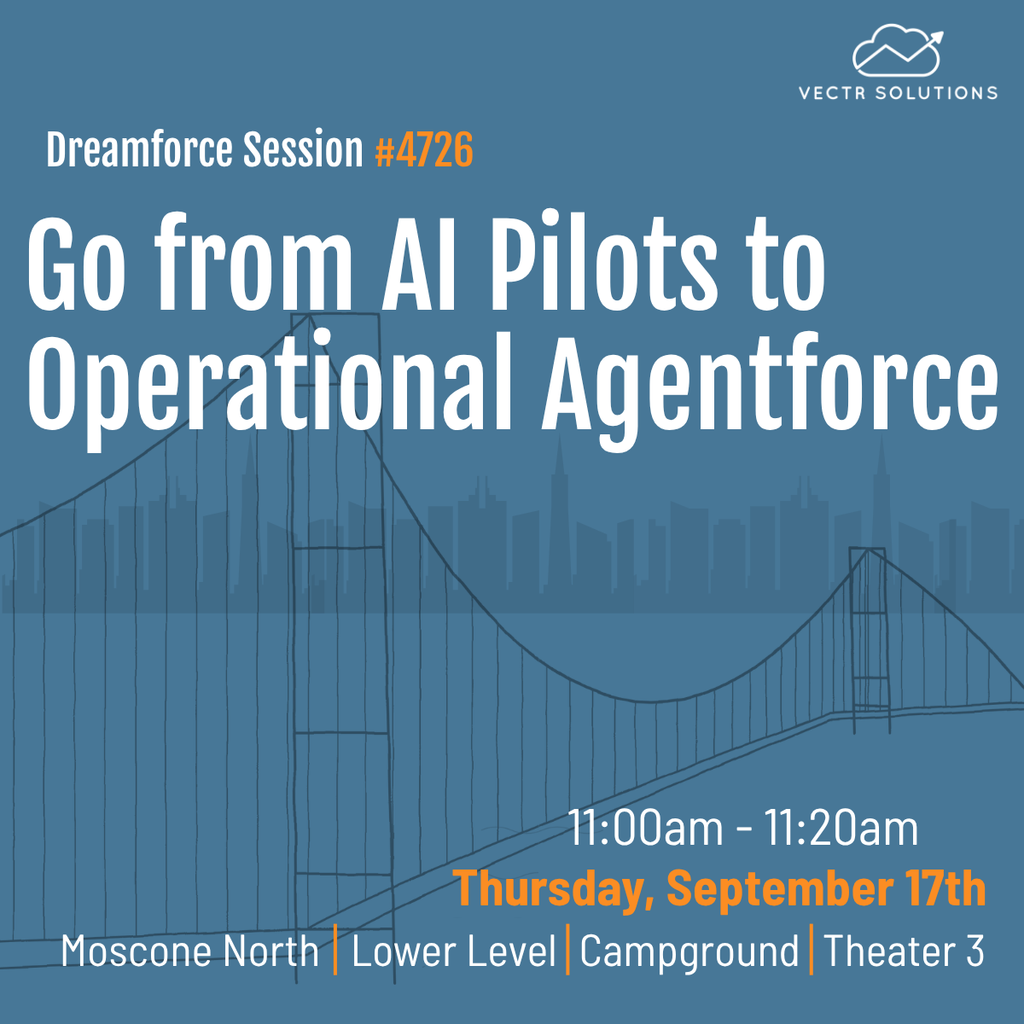
Go from AI Pilots to Operational Agentforce
Session 4726
September 17, 2026 | 11:00–11:20 AM
Moscone North | Lower Level | Campground | Theater 3
The session will explore how a leading nonprofit developed an Agentforce roadmap and phased governance approach to move beyond disconnected AI pilots and toward operational workflows and to me, that’s one of the most important conversations organizations can be having about AI right now.
There isn’t a shortage of AI ideas. The challenge is deciding which ideas deserve to become real solutions and then building the governance, roadmap, data foundation, and processes necessary to make them sustainable.
We’re not going to Dreamforce just to talk about what Agentforce could do. We’re going to show what moving toward operational Agentforce actually looks like. If you’re working through that same transition inside your organization, put this one on your Dreamforce agenda.
We’re Bringing Something Else to San Francisco, Too
There’s another conversation I’m particularly excited for Vectr to have at Dreamforce this year and this one starts with a completely different problem:
Why is managing a bid still so complicated?
For many organizations pursuing government and enterprise opportunities, the process can span procurement portals, inboxes, spreadsheets, shared drives, collaboration tools, proposal documents, contract systems, and a lot of institutional knowledge living inside people’s heads.
- An opportunity gets discovered in one place.
- The bid/no-bid conversation happens somewhere else.
- Proposal development happens somewhere else.
- Reporting happens somewhere else.
Then if you win the contract management begins another process entirely. We’ve been thinking about what happens when Salesforce becomes the platform connecting that entire lifecycle.
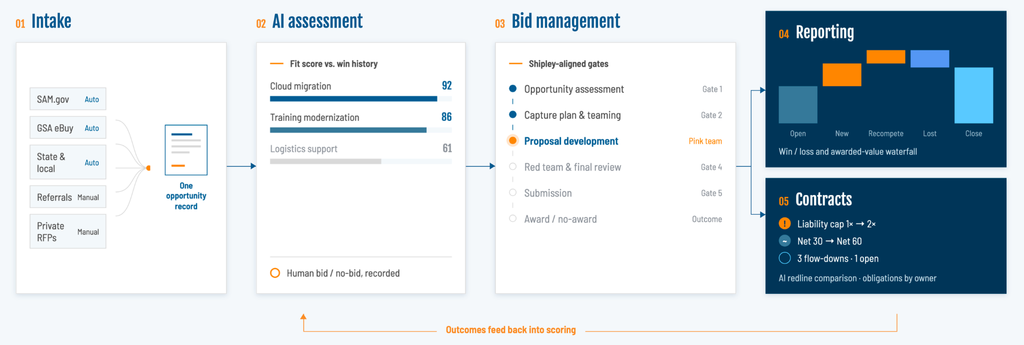
The result is the latest solution we’re bringing to Dreamforce: End-to-End Bid Management built on Salesforce.
Discover. Assess. Pursue. Measure. Manage.
The idea is straightforward: create one connected process from solicitation discovery through award, reporting, and contract management.
It starts with Intake. Opportunities from sources like Sam.Gov and other procurement portals can enter the process alongside referrals, teaming opportunities, and private RFPs, ultimately becoming a consistent opportunity record.
Then comes AI Assessment.
Instead of asking a capture team to manually dig through every new solicitation, AI can help summarize requirements and assess fit using factors such as previous wins and losses, capabilities, past performance, vehicle eligibility, incumbent information, and current capacity.
But there’s an important distinction here…the decision stays human.
AI helps the team understand the opportunity and the reasoning behind an assessment. The actual bid/no-bid decision remains with the people responsible for making it.
For opportunities worth pursuing, the process moves into a Shipley-aligned Bid Management workflow, including defined gates, owners, due dates, compliance requirements, reusable proposal content, reviews, submission, and ultimately award or no-award.
And because those outcomes live in the same connected process, Reporting & Analytics can answer questions that are often surprisingly difficult:
- What are we winning?
- What are we losing?
- Why are we losing?
- Where is awarded value coming from?
- What should those outcomes teach us about the next opportunity we evaluate?
Finally, when an opportunity becomes an award, the information doesn’t disappear into another disconnected system. Contract Management can continue the process by tracking obligations, clause changes, versions, and responsibilities.
That’s the part of this solution we are most excited about. It isn’t AI bolted onto another isolated process but rather an example of what we’ve been talking about throughout this article: putting AI, data, and automation inside an actual end-to-end business workflow.
And we can’t wait to start showing it to people at Dreamforce.
Dreamforce Number Four
There’s another reason I’m looking forward to getting back to San Francisco. This will be Vectr’s fourth Dreamforce, and after a few of these, you start to realize that some of the best parts of Dreamforce aren’t necessarily the things you can predict beforehand.
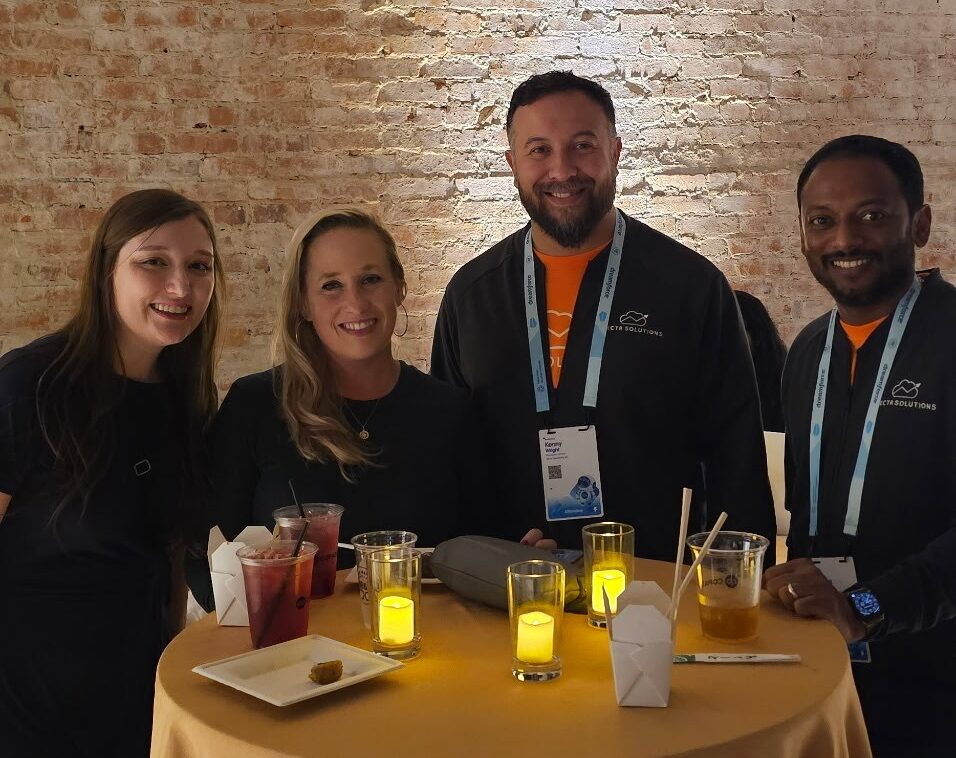
Obviously, I’ll be watching the keynotes and product announcements, but I also want to see what people are actually building.
I want to hear what customers say is working, what isn’t working, to see the demos that make you stop walking through the Campground and say, “Wait…show me that again”, and I’m especially interested in the conversations between sessions. The ones where somebody describes a problem they’re trying to solve and suddenly you’re sketching something out together.
Four years also gives us a pretty interesting measuring stick. The Salesforce ecosystem moves incredibly fast. Ideas that felt experimental a few Dreamforces ago are becoming real parts of how organizations operate.
So yes, I want to see what’s next, but this year, I’m equally interested in seeing what’s working now.
Not Going to San Francisco? You’re Still Part of Dreamforce.
Last year, we published an entire guide around this idea: you don’t need a badge to win Dreamforce.
And I still believe that.Salesforce+ has made Dreamforce much bigger than what’s happening inside Moscone Center. If you can’t make the trip this year, you can still follow keynotes, sessions, product announcements, demos, and conversations happening throughout the week.
My advice from last year still stands:
- Don’t treat virtual Dreamforce like background noise.
- Pick the topics that matter to you.
- Block time.
- Watch intentionally.
- Take notes.
- Share what you’re learning
- And figure out what you’re actually going to do with it.
You can check out our Dreamforce You Don’t Need a Badge For guide for the full playbook on getting the most from Salesforce+, and this year, there will be another way to follow along.
We’ll be sharing what we’re seeing, what we’re learning, and what we’re bringing to Dreamforce throughout the event. So whether you’re walking around Moscone with us or following from your desk, stay connected with Vectr Solutions!
See You at Dreamforce
Dreamforce has always been about seeing what’s next. This year, I’m just as interested in seeing what’s actually working.
For Vectr Solutions, that means talking about how organizations can move from isolated AI pilots toward operational Agentforce. It means showing how the Salesforce platform can be applied to complex processes like end-to-end Bid Management. And it also means spending three days learning from customers, Salesforce leaders, partners, builders, admins, and everyone else who makes this ecosystem what it is.
If you’re heading to San Francisco, COME FIND US!
- If you’re working through how to take Agentforce from experimentation to operations, join us September 17 at Theater 3.
- If Bid Management is a challenge inside your organization, let us show you what we’re building.
- And if you’re watching from home, follow along. You don’t need a badge to be part of the conversation.
Four years in, I’m ready for my first Dreamforce and I know the rest of the team feels the Same! See you in San Francisco!