

Key Takeaways
- Gartner predicts that by 2027, 40% of enterprises will demote or decommission autonomous agents because governance gaps only surface after a production incident, not because the technology fails.
- A roadmap only counts once it produces a working, deployed agent, not another strategy deck.
- Pick a first use case with high data availability, manageable scope, and a metric leadership already tracks.
- Governance, access controls, and human-in-the-loop checkpoints belong in the plan on day one, not bolted on after the pilot.
- Deployment moves through stages: assessment, pilot, scaled rollout, and ongoing optimization. Skipping a stage is usually where timelines slip.
- Vectr Solutions builds Agentforce roadmaps that end in production, using Prosci-certified change management and architects who’ve done this inside Government Cloud, nonprofit, and GovCon environments.
Enterprise AI is moving from passive conversational tools to autonomous operational agents. Inside the Salesforce ecosystem, Agentforce represents that shift concretely: instead of answering a basic question, an agent can now execute a multi-step business process across your CRM data.

The potential is real. So is the gap between a roadmap slide and a working agent. High-level strategies tend to fall apart the moment they meet legacy data structures, security requirements, and organizational habits that were never designed with autonomous decisioning in mind.
An actionable AI roadmap is the bridge between the ambition and the execution: it forces an honest look at readiness, defines the rules of engagement before anything goes live, and treats change management as part of the build, not an afterthought.
Why Most AI Roadmaps Stall Before Agentforce Goes Live
The gap between the executive strategy deck and the live technical build is the single biggest source of friction in enterprise AI. Strategy decks describe transformation. They rarely account for the data hygiene, system architecture, and governance model an autonomous agent actually needs once it is doing real work. Gartner predicts that by 2027, 40% of enterprises will demote or decommission autonomous agents because governance gaps only get discovered after a production incident, not before one.
Broader generative AI research shows the same pattern: more than half of initial pilots never reach production. Fragmented data, inconsistent record maintenance, and governance boundaries that were never written down are the usual points of failure.
Without a structured approach to data, agents simply do not have the context to make accurate, real-time decisions, no matter how capable the underlying model is.
There is also a market noise problem. Plenty of chatbots and basic automation tools are getting rebranded as “agentic AI” without the multi-step reasoning to back it up. When one of these rebranded tools fails to deliver, executive trust takes the hit, and it stalls investment in the projects that would have actually worked. Cutting through that noise means going back to fundamentals: data health, governance, and workflow design, in that order.
What an Agentforce-Ready AI Roadmap Actually Includes
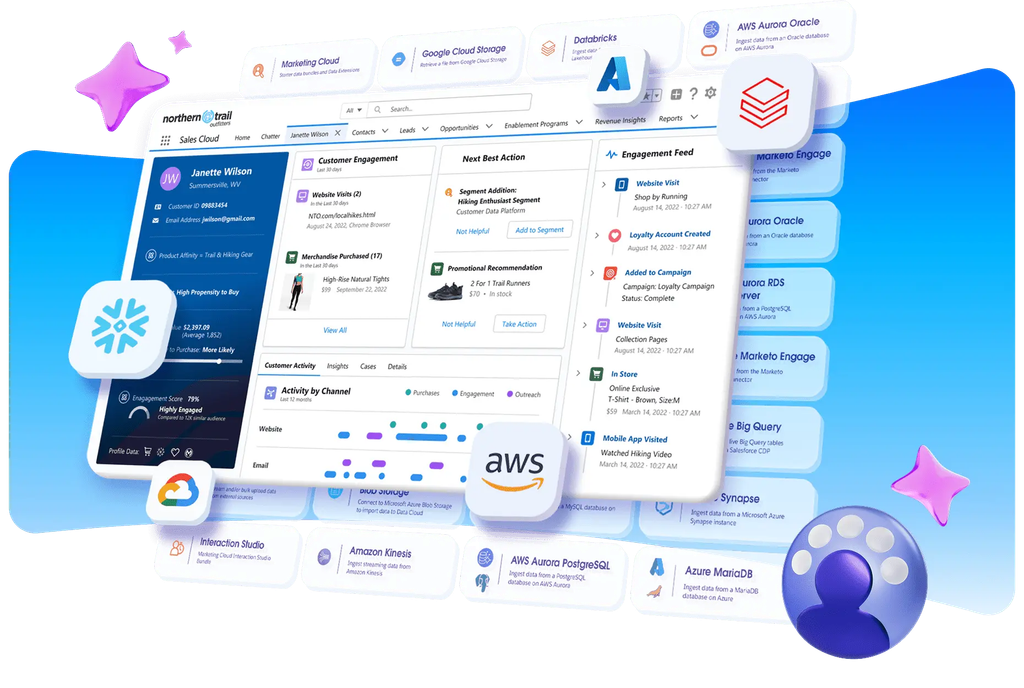
A roadmap that survives contact with implementation skips the vague innovation language and gets specific about engineering and operational readiness. It starts with an AI readiness assessment: an honest audit of data quality, system integrations, and Salesforce org health. Agents reason against whatever data foundation you give them, so a governed Data 360 foundation needs to be settled before an agent goes anywhere near production, not treated as a parallel workstream.
Source: https://www.salesforce.com/data/how-it-works/
From there, the roadmap needs a real framework for prioritizing use cases instead of trying to automate everything at once. Effective roadmaps target processes with clear success criteria and a measurable return, which protects resources and builds the kind of early momentum that gets a second and third use case funded.
Governance and operational guardrails belong at the outset, not as a post-launch patch. That means defining data security parameters, permission boundaries, and audit protocols before the agent is doing anything a human would need to sign off on. And change management has to be embedded in the plan itself. Staff need to understand what is changing in their workflow and why, or adoption stalls no matter how well the agent performs technically.
An AI roadmap built for implementation
Three steps in order, with governance and change management running the full length. Select any part of the map to see what it covers.
Prioritizing Agentforce Use Cases
Picking the right starting point matters more than picking an ambitious one. Strong first use cases combine high data availability with a manageable scope and a success metric leadership already tracks. That combination is what lets a pilot actually prove something instead of generating a demo that never scales.
Automated case deflection is a common and reliable starting point. Agents can evaluate inbound inquiries in Agentforce Service, execute routine account updates, and walk a user through structured troubleshooting without a human touching the ticket. Internal knowledge automation is another strong candidate, where an agent queries internal repositories to generate compliant documentation or support staff workflows directly.
What makes a strong first use case
The right starting point meets all three criteria. Pick a candidate to see how it measures up.
- High data availability
- Manageable scope
- A metric leadership already tracks
Vectr Solutions has built agentic use cases across similarly constrained environments: agents that parse compliance requirements and flag flow-down clauses for public sector contracting teams, agents that read and classify RFPs to speed up bid and no-bid decisions, and agents that unify fragmented donor data for nonprofit fundraising teams.
In each case, the win came from starting narrow, with a defined process and a measurable outcome, not from trying to automate an entire department on day one.
Governance Considerations for Agentic AI
Putting autonomous software into production requires real governance, not a policy document that gets written after the fact. Governance is the blueprint that defines exactly how an agent is allowed to interact with sensitive data. Role-based access controls are the foundation: an agent should only see the fields a human in that role would be allowed to see. No exceptions for "the AI needs it to be smart."
That governance model also cannot be uniform across every agent. A read-only agent that summarizes case notes carries a different risk profile than one that can update records or send a client-facing message, and it needs a different level of oversight to match. Treating every agent the same way regardless of what it is actually allowed to do is exactly the kind of governance gap that only surfaces once something has already gone wrong in production.
Human-in-the-loop checkpoints matter just as much. Routing complex approvals, financial transactions, or policy exceptions to a person keeps the organization in control of the decisions that actually carry risk, while letting the agent handle the repetitive work around them.
Regulated environments carry an additional layer. Public sector agencies, defense contractors, and nonprofits operating under grant compliance need Agentforce deployments that align with standards like FedRAMP, CMMC, and ITAR, along with the activity logging and policy-based guardrails that make audits survivable instead of stressful. Agentforce now holds FedRAMP High authorization on Government Cloud Plus, but that covers the platform, not how your agents are configured.
This is the layer where a lot of roadmaps built by generalist consultants fall apart, because the governance model has to be designed for the compliance environment from the start, not retrofitted onto it.
From Roadmap to Deployment: What Changes at Each Stage
Moving from plan to production happens in stages, and skipping one is usually where a timeline quietly falls apart. Assessment and discovery is the technical health audit: workflow mapping, data readiness, and the baseline governance model. Pilot and validation moves the concept into a controlled environment, where teams test boundary controls, evaluate response accuracy, and refine human-in-the-loop triggers based on real feedback.
-
Assessment and discovery Workflow mapping, data readiness, and the baseline governance model
-
Pilot and validation Boundary controls, response accuracy, and human-in-the-loop triggers, tested with real feedback
-
Scaled rollout Structured training that turns quiet resistance into adoption
-
Ongoing optimization Execution metrics, consumption and license costs, and expansion into adjacent processes
Scaled rollout is where change management earns its keep. Structured training prepares staff to work alongside the agent, which drives adoption instead of quiet resistance. Ongoing optimization comes after launch: tracking execution metrics, managing consumption and license costs, and expanding the agent's scope into adjacent processes once the first use case is proven.
What to Ask Before You Commit to an Agentforce Roadmap
Before committing a budget, leadership should push on three areas.
- Is enterprise data structured, cleansed, and accessible through APIs, or will data silos slow the agent down before it ever reaches a user?
- Who is accountable for setting permission boundaries, reviewing activity logs, and keeping compliance current as the agent’s scope grows?
- How does the implementation partner measure success after launch, not just at go-live?
A partner who cannot answer how they track adoption and cost savings six months in is not planning for production. They are planning for a demo.
How Vectr Solutions Helps Organizations Move From Roadmap to Deployment
Turning an AI roadmap into a production system takes technical depth and hands-on delivery experience, not another strategy deck. We work as a delivery-first partner through every stage of the Agentforce journey, from the initial AI readiness assessment to a governed, live deployment.
That work is grounded in Prosci™-certified change management woven directly into the rollout, so technical go-live and user adoption move together instead of one waiting on the other. Vectr's Salesforce architects design secure agent architectures on a governed Data 360 foundation, configure the guardrails a compliance team will actually sign off on, and build agent-to-agent orchestration through MuleSoft Agent Fabric where a workflow needs more than one agent working in sequence.
With deep experience across public sector agencies, nonprofits, and government contractors, we understand what it takes to deploy agentic AI inside environments where FedRAMP, CMMC, and ITAR are not optional considerations. That is the difference between a roadmap that reads well in a boardroom and one that turns into a working agent your team actually uses.