
Every enterprise scaling its AI investment faces a critical moment—the shift from deploying systems to governing them. When autonomous AI agents are coordinating complex, end-to-end service workflows, generating billions of interaction points across live customer deployments, the question is no longer just if the agents are working, but how well they are performing, right now.

For years, service operations relied on retrospective Business Intelligence (BI), analyzing yesterday’s data to adjust tomorrow’s strategy. But in the age of agentic AI, a reactive approach is a strategic liability. The sheer velocity and volume of telemetry generated by these systems demand continuous observability. What Salesforce architects, analytics leads, and service operations leaders need is a high-speed data-to-action framework: the ability to detect, anticipate, and act before an agent error leads to a case failure, customer churn, or a compliance breach.
That is the definitive purpose of uniting Agentforce (Salesforce’s unified AI service platform, featuring autonomous reasoning engine capabilities) with CRM Analytics (the native analytics solution within Salesforce, formerly marketed as Tableau CRM). This combination is more than a technical integration; it is the architectural standard for achieving true operational observability in an AI service environment.
We see this pairing as a strategy to merge the speed of AI automation with the precision of data science, giving leaders actionable, real-time control over their largest AI investments.
Why Real-Time Analytics Is Critical for AI Agent ROI
The strategic case for real-time visibility is rooted in the opportunity for rapid intervention. Traditional, post-mortem analysis only confirms a failure; real-time guidance influences customer outcomes as they happen, preventing minor agent errors from escalating into full case failures.
By monitoring high-leverage causal indicators—specifically agent error rates and latency—organizations can proactively guide the AI or escalate to a human supervisor. This provides a direct, measurable causal link between analytics investment and core business performance:
- Elevated Resolution Quality: Real-time systems enable a potential 5% to 15% increase in First Contact Resolution (FCR) and corresponding improvements in Customer Satisfaction (CSAT). One customer doubled FCR in just four months after implementing Agentforce-powered assistance.
- Operational Efficiency: The continuous data loop shortens resolution cycles, often leading to a 10% to 30% reduction in Average Handle Time (AHT). We have tracked average monthly growth in agent actions exceeding 100% across multiple key industries, demonstrating the massive scaling potential enabled by this efficiency.
- Strategic ROI and Risk Management: Agentic AI’s value extends beyond simple cost reduction, offering gains in productivity and strategic agility. Real-time monitoring provides the necessary framework to quantify this broader value, connecting operational gains directly to strategic business indicators like Customer Retention Rate or Pipeline Cycle Length. Furthermore, continuous tracking of every agent action enables instantaneous monitoring to spot and mitigate compliance and regulatory risks as they occur.
Crucially, real-time analytics provides necessary visibility into adoption. Without continuous monitoring of metrics like task completion and user satisfaction, organizations cannot confirm if their agents are delivering on the promise of speed or if users are encountering friction that leads to low adoption and eventual abandonment.
Agentforce: The Engine of Action, Grounded in Data
Agentforce, which functions as a reasoning layer, dynamically automates tasks, interprets complex conversations, and summarizes records from a consistent conversational user interface across the Salesforce platform. Its ability to deliver real, scalable results hinges on the meticulous, real-time tracking of every step in the agentic workflow.
The foundational technology that makes real-time Agentforce analytics possible is Data 360. This platform serves as the central, high-velocity repository for the immense telemetry generated by the generative AI system. This architecture establishes Data 360 as the single source of truth for all operational metrics.
All Agentforce performance and quality metrics, including specialized features like Utterance Analysis (which tracks user requests and agent success rates), are fundamentally built upon Data 360’s Generative AI Data Model Objects (DMOs). Analyzing agent success requires complex data joins to correctly link the unstructured Generative AI DMOs back to structured CRM DMOs, a vital step executed through CRM Analytics’ powerful Data Prep layer.
While Agentforce includes a Command Center for immediate, real-time observation of agent performance, it is CRM Analytics that provides the strategic extension. It allows analytics leads to perform custom, correlative reporting and deep slicing of data—such as correlating adoption by geography or job role with specific performance metrics—that may not be available in the default Command Center view.e.
CRM Analytics: Prescriptive Foresight in the Flow of Work
CRM Analytics provides the essential capabilities to transform high-velocity Agentforce telemetry into actionable intelligence, natively integrated into the Salesforce ecosystem.
Its strength lies in three core, interconnected areas:
Embedded Analytics: CRM Analytics provides robust embedded analytics, allowing insights and actionable dashboards to be seamlessly integrated directly into Agentforce consoles and other Salesforce applications. By placing a real-time FCR prediction score or a compliance risk meter directly into the Service Console, continuous feedback is delivered precisely where the human agent is working, enhancing adoption and reducing context switching.
Native Integration and Predictive AI: CRM Analytics is purpose-built to provide contextual insights and AI-powered predictions directly in the flow of work. By using Tableau Semantics, the platform ensures consistent, shared metric definitions across the entire enterprise. Furthermore, through Einstein Discovery, CRM Analytics moves beyond descriptive analysis, predicting potential outcomes and key drivers, and then suggesting the next best action. This is central to Agentforce operational control: CRM Analytics can be trained to predict the likelihood of an ongoing agent interaction failing or escalating based on real-time telemetry parameters.
The Action Framework: This is where the analytics loop truly closes. CRM Analytics’ built-in Action Framework eliminates latency by enabling users to take immediate, data-driven action—such as triggering a Salesforce Flow, updating a record, or escalating a case—directly from the dashboard insight. This programmatic response ensures the real-time insights are operationally viable.
The Synergy: A Closed-Loop System for Operational Control
The integration of Agentforce and CRM Analytics is an architectural design that facilitates a continuous, high-speed data pipeline for operational control.
The data flow begins with the continuous capture of Agentforce telemetry events, which are streamed into Data 360 using the CRM Connector. This ingestion leverages Data 360’s Stream Processing functionality for minimal latency, a mandatory architectural choice for any real-time use case. Once processed, the data powers CRM Analytics dashboards that monitor high-frequency leading indicators, often established using the platform’s Time Series Forecasting capabilities to monitor against a normal range.
The synergy reaches its operational peak when CRM Analytics insights trigger prescriptive automation. When Einstein Discovery predicts a high risk of failure, the Action Framework is immediately configured to initiate a Salesforce Flow. This flow can execute rapid, programmatic responses, such as automatically routing the interaction to a specialized human supervisor, or adjusting the agent’s prompt instructions in real-time.
Architectural Vigilance: Critical Implementation Considerations
Successfully deploying this high-velocity, real-time architecture requires stringent planning focused on data management, security, and performance.
Data Latency and Quality
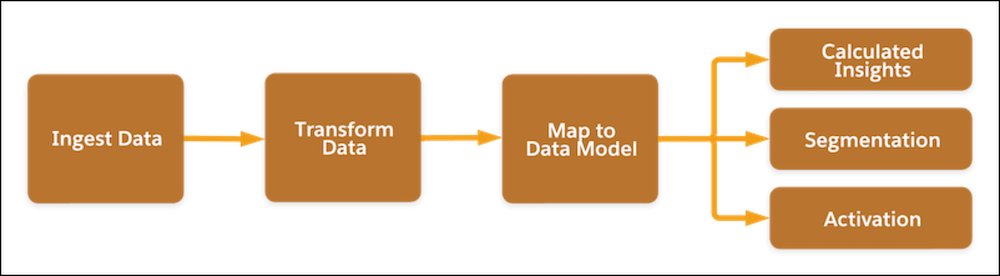
For operational real-time analytics, Stream Processing in Data 360 is mandatory. Architects must ensure strict adherence to Data 360 requirements, as simple errors—such as including a formula field in the data stream—can force the system into batch processing mode, introducing unacceptable latency.
Source: https://help.salesforce.com/s/articleView?id=data.c360_a_streaming_transform_overview.htm&type=5
Furthermore, raw agent telemetry can be noisy or sparse. The strategy must shift from simply reporting every event to using Einstein Discovery for risk-based alerting, prioritizing only those alerts that predict high operational impact. We also integrate sophisticated data preparation techniques within the CRM Analytics Data Prep layer, including filtering techniques (to smooth random noise) and statistical imputation methods for missing sequential telemetry data, ensuring trends are statistically sound.
Governance and Row-Level Security (RLS)
Given the sensitivity of customer interaction data, robust data governance is paramount. A Data Governance Policy must be implemented in Data 360, and Row-Level Security (RLS) is essential to ensure that analytics leads and managers only view data relevant to their teams or scope of control. The best practice is to define RLS policies at the Data 360 DMO level, leveraging contextual fields like record ownership, thereby ensuring consistent security across all consuming applications, including CRM Analytics dashboards.
How Vectr Solutions Supports Your Deployment
The architecture uniting Agentforce, Data 360, and CRM Analytics’ streaming analytics architecture demands deep, specialized expertise.
- Architecture Design and Integration Planning: We design the high-speed streaming telemetry pipeline, ensuring Data Model Object compatibility for low-latency ingestion, and defining the crucial semantic layer using Tableau Semantics. We also audit existing stacks to architect the required RLS structures for compliance and scalability.
- Pilot Dashboards, Templates, and Modules: We deploy high-impact operational dashboards, specializing in embedding prescriptive Einstein Discovery models directly into Agentforce consoles, transforming passive data into actionable guidance for service teams.
- Training, Support, and Optimization Services: We offer custom training programs on leveraging CRM Analytics’ Time Series Forecasting capabilities for capacity planning, along with advanced techniques for effective noise mitigation and alert tuning. Critically, we guide organizational change management by positioning the analytics system as a support mechanism, fostering agent adoption and reducing resistance.
For any enterprise serious about scaling its investment in agentic AI, real-time analytics is not an optional feature—it is the indispensable infrastructure required for operational control, continuous optimization, and the realization of quantifiable ROI. The combination of Agentforce and CRM Analytics, unified by the Data 360, provides the only truly low-latency, closed-loop system for AI operational management within the Salesforce platform.