
For over a decade, Salesforce CPQ was the answer to a very specific problem: how do you stop a sales rep from quoting a price that doesn’t exist. It did that job well. But “quote it correctly” and “run your entire revenue operation” are two very different problems, and Salesforce has spent the last few years building a platform for the second one. If you’re still running CPQ, or evaluating whether to move, the terminology alone is enough to make your head spin. Revenue Cloud, Revenue Lifecycle Management, Agentforce Revenue Management. Same platform, three names, and a lot of confusion about what actually changed underneath.
We work through this exact transition with government contractors and public sector organizations, where a platform decision isn’t just a sales ops question. It’s a compliance question, an ERP integration question, and sometimes an authorization-boundary question. That’s the lens we’ll use here.
Understanding Salesforce CPQ
CPQ stands for Configure, Price, Quote, and it did exactly that: helped reps assemble complex product bundles, apply the right discount logic, and generate a clean quote document without emailing finance six times to confirm a number. It cut down approval loops and kept unauthorized pricing out of proposals.
Configure, price, quote
Hover over a step, or tap it, to see how Salesforce CPQ moves a deal from product selection to a signed quote.
The catch is right there in the name. CPQ’s logic was built to evaluate a deal at the moment of the quote, and it mostly stopped caring once the deal closed. Billing, renewals, and contract amendments lived in other systems, which meant someone was always reconciling data between CPQ and whatever ran downstream. For simple, one-time, deal-based sales, that was tolerable. For anything recurring, it became a permanent source of manual cleanup.
What Is Salesforce Revenue Cloud?
Salesforce’s answer, and its replacement for CPQ, was Revenue Lifecycle Management, later renamed Revenue Cloud and now marketed as Agentforce Revenue Management following the 2025 rebrand. The name has changed more than once but the direction hasn’t, which is to manage the full quote-to-cash lifecycle, natively, on the core Salesforce platform, instead of bolting a quoting tool onto Sales Cloud and hoping everything downstream lines up. Most buyers still search for it as Revenue Cloud, so that’s the name we use here.
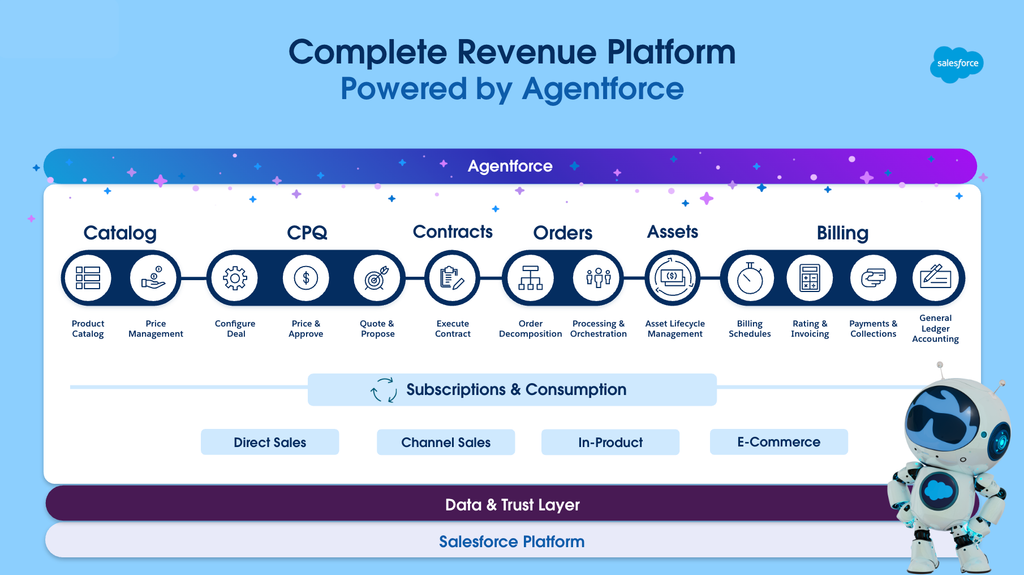
That native part matters more than it sounds. CPQ was a managed package sitting on top of Salesforce. Revenue Cloud is built directly into the platform’s data model, which also matters for organizations running in Salesforce Government Cloud, something we’ll come back to.
Layered on top of that native architecture is Agentforce, which brings AI into the workflow itself: automated quote generation, intelligent approval routing, and renewal recommendations based on actual usage data rather than a rep’s gut feeling.
What’s Changed?
From quoting to lifecycle management. CPQ handled the front end and stopped. Revenue Cloud governs quoting, contracts, orders, billing, and renewals as one continuous process, which means a mid-term contract amendment gets captured automatically instead of triggering a spreadsheet fire drill.
Native platform architecture. Because Revenue Cloud runs on the core platform instead of a managed package, it scales more predictably and integrates more cleanly with tools like Data Cloud and MuleSoft. Custom Apex workarounds that used to hold CPQ together become far less necessary.
AI and automation. Where CPQ needed an administrator to manually rebuild pricing rules every time a model changed, Agentforce capabilities apply real-time data to suggest terms, flag approvals, and surface renewal opportunities before they’re missed.
Salesforce CPQ vs Revenue Cloud
| Area | Salesforce CPQ | Revenue Cloud |
|---|---|---|
| Scope | Configure, price, quote | Complete revenue lifecycle |
| Catalog | Product configuration | Advanced catalog management |
| After the sale | Quote generation | Contracts, orders, billing |
| Approvals | Basic approvals | AI-powered automation |
| Built on | Legacy add-on package | Native Salesforce platform |
Salesforce CPQ is no longer sold to new customers. Existing customers still get support.
Do Existing CPQ Customers Need to Migrate?
Not immediately, but the runway is shorter than it used to be. Salesforce CPQ as a standalone product has reached end-of-sale and is now in a maintenance-only phase, meaning it still runs, but it isn’t where new investment is going. Organizations with simple, one-time sales and minimal billing complexity can reasonably stay put for now.
For government contractors specifically, there’s an added wrinkle. New Government Cloud investment is going into the native platform, not legacy CPQ, so confirm which Revenue Cloud features are available in your Government Cloud environment before you design around them. If your organization is managing complex government SKU structures, subscription-based service contracts, or usage-based billing tied to a federal program, staying on legacy CPQ isn’t just a technical debt problem. It’s increasingly the less-supported path inside the authorization boundary you’re required to operate in. A phased migration, standardizing quoting today while architecting for Revenue Cloud, tends to be the more defensible route.
Not sure where your CPQ setup stands? Speak to an expert.
Benefits of Moving to Revenue Cloud
A unified quote-to-cash process means sales and finance are finally looking at the same numbers instead of reconciling two versions of the truth. That translates into cleaner reporting, less manual data entry, fewer billing errors, and a renewal process that doesn’t rely on someone remembering a contract is up in 45 days. For organizations layering in AI-driven forecasting, it also means the recommendations are only as good as the underlying data, which is exactly why the next section matters.
Common Migration Challenges
Product catalogs built up over years of CPQ bundles and workarounds don’t map cleanly to Revenue Cloud’s normalized data model, so catalog redesign is almost always step one. Pricing logic built through custom Apex has to be rethought for the native platform rather than ported over as-is. Data migration and ERP integrations, particularly for organizations connecting to Costpoint, NetSuite, or similar systems for revenue forecasting, need careful sequencing so nothing breaks mid-transition. And because this changes how sales and finance teams actually work day to day, change management is not optional.
Best Practices Before Migrating
Start with an honest assessment of your current CPQ implementation, including the custom logic nobody’s documented in three years. Clean your product and pricing data before it moves anywhere, not after. Identify the process improvements you actually want out of this, not just a lift-and-shift. Plan integrations early rather than as an afterthought. And work with consultants who’ve done this specific migration before, not just a general Salesforce build.
How Vectr Solutions Helps Organizations Transition
We approach a Revenue Cloud migration the same way we approach any Salesforce implementation: Discovery, Setup, Extend, Enhance. Discovery maps your current CPQ configuration, pricing logic, and integration points so nothing gets missed. Setup stands up the highest-impact pieces of Revenue Cloud first, so your teams see value quickly instead of waiting a year for a big-bang launch. Extend brings in the surrounding business processes, including MuleSoft integrations with ERP systems like Costpoint and NetSuite for accurate revenue forecasting. Enhance is ongoing: ensuring your internal team is trained to run the platform, with our Salesforce Managed Services team available after launch.
For public sector and government contractor organizations, we also bring the compliance layer most generalist consultants don’t: FedRAMP and DoD authorization requirements, security controls appropriate to your GovCloud environment, and an understanding of what’s actually authorized versus what’s still on the roadmap.
Plan Your Salesforce Revenue Cloud Journey with Confidence
Whether you’re evaluating Revenue Cloud for the first time or planning a migration off legacy CPQ, having a partner who’s done this inside regulated environments makes the difference between a clean transition and a compliance headache. Speak to an expert and let’s map out your Revenue Cloud roadmap.