
We are living in an era of seamless digital convenience. When a single click can deliver groceries to your door, it is only natural that constituents expect the same speed and simplicity from public sector services. Exceptional digital design is no longer a luxury. It has become the bedrock of public trust. When online portals are slow, confusing, or fragmented, citizens quickly become frustrated, and valuable agency resources are drained by routine requests that could easily be resolved through self-service.

This is why modern public sector leaders are shifting their focus away from basic digital access. Agency executives and IT directors are making the overall user experience a primary driver of strategic IT planning and long-term modernization. The goal is to move beyond simply migrating workloads to the cloud and toward fundamentally reimagining how agencies interact with the public.
Why Agencies Are Looking Beyond Traditional Government Systems
Historically, government IT infrastructure has relied on custom-built legacy software. While these systems served their purpose in previous decades, they have become incredibly expensive to maintain and highly vulnerable to modern security risks.
To put this in perspective, the federal government spends more than $100 billion a year on IT, and according to the GAO, roughly 80 percent of that goes toward operating and maintaining existing systems, much of it aging legacy infrastructure. That financial drag severely limits an agency’s ability to innovate or scale.
Another critical issue is the presence of disjointed data silos. Across the public sector, a large share of applications remain disconnected from one another, leaving valuable constituent data locked in separate departmental databases. When departments operate in isolation, citizens are forced to tell their story multiple times to different caseworkers, which creates real frustration.
Legacy architectures are also too rigid to adapt quickly when public policies change. Digital government initiatives built on fragmented, siloed technology consistently struggle to meet their objectives, which is exactly why moving away from these systems is now a top priority.
Why Salesforce Fits Modern Government Needs
To overcome the limitations of old software, public sector leaders are shifting toward a platform-centric approach, and government IT investment is increasingly moving toward modern as-a-service cloud solutions. This is where a Salesforce-based digital government strategy becomes highly effective.
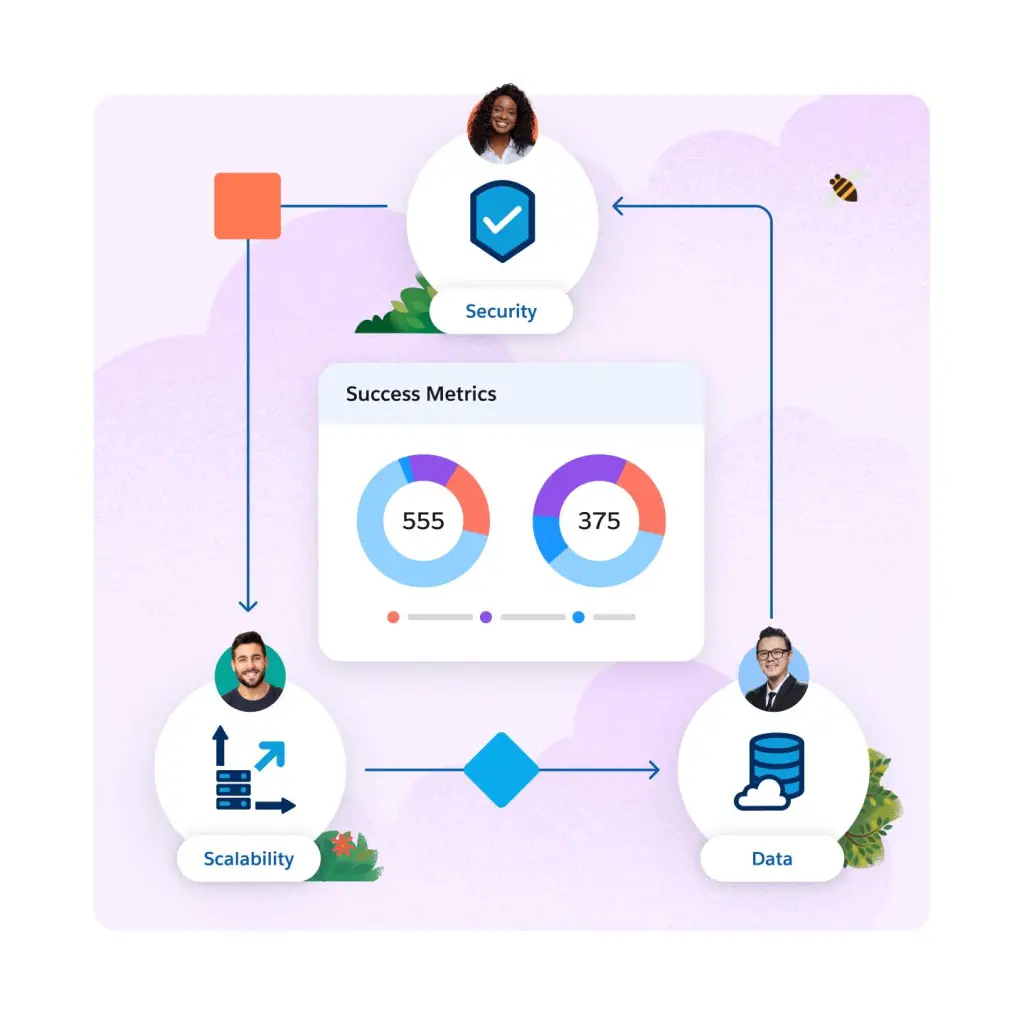
Instead of building custom software for every department, agencies can adopt a unified CRM platform that scales across multiple offices. Salesforce’s public sector architecture is built specifically to handle the high-security compliance needs of modern agencies. It provides dedicated hosting options that comply with stringent security baselines, including FedRAMP High and IRS 1075, with DoD Impact Level 2 on Government Cloud Plus and Impact Levels 4 and 5 available on the Government Cloud Plus Defense environment.
Source: https://www.salesforce.com/government/cloud/
This level of security allows agencies to process sensitive data like Controlled Unclassified Information and Personally Identifiable Information with confidence. Best of all, the platform relies on low-code tools like OmniStudio and the Business Rules Engine, so administrators can visually design guided workflows and modify eligibility rules without writing thousands of lines of custom code.
Modernizing the Constituent Experience
Let’s look at how this works in practice. Imagine a state agency modernizing its public inquiry and service request portal. In the old legacy world, citizens had to fill out confusing paper forms or navigate fragmented websites, leaving them in the dark about their status.
With a modernized setup, a citizen logs onto a clean, mobile-friendly self-service portal built with Experience Cloud. They can submit a request, upload documents, and track progress in real time. Guided digital workflows ensure every field is filled out correctly the first time.
On the backend, the request does not sit in a manual email inbox. The system uses automated business rules to instantly route the ticket to the correct department. Because the process is transparent and tracked, response times drop and public trust strengthens.
Optimizing Grant and Program Management
Now consider an agency managing federal grants or public benefits. Historically, verifying applicant eligibility and tracking compliance required endless spreadsheets and manual data entry.
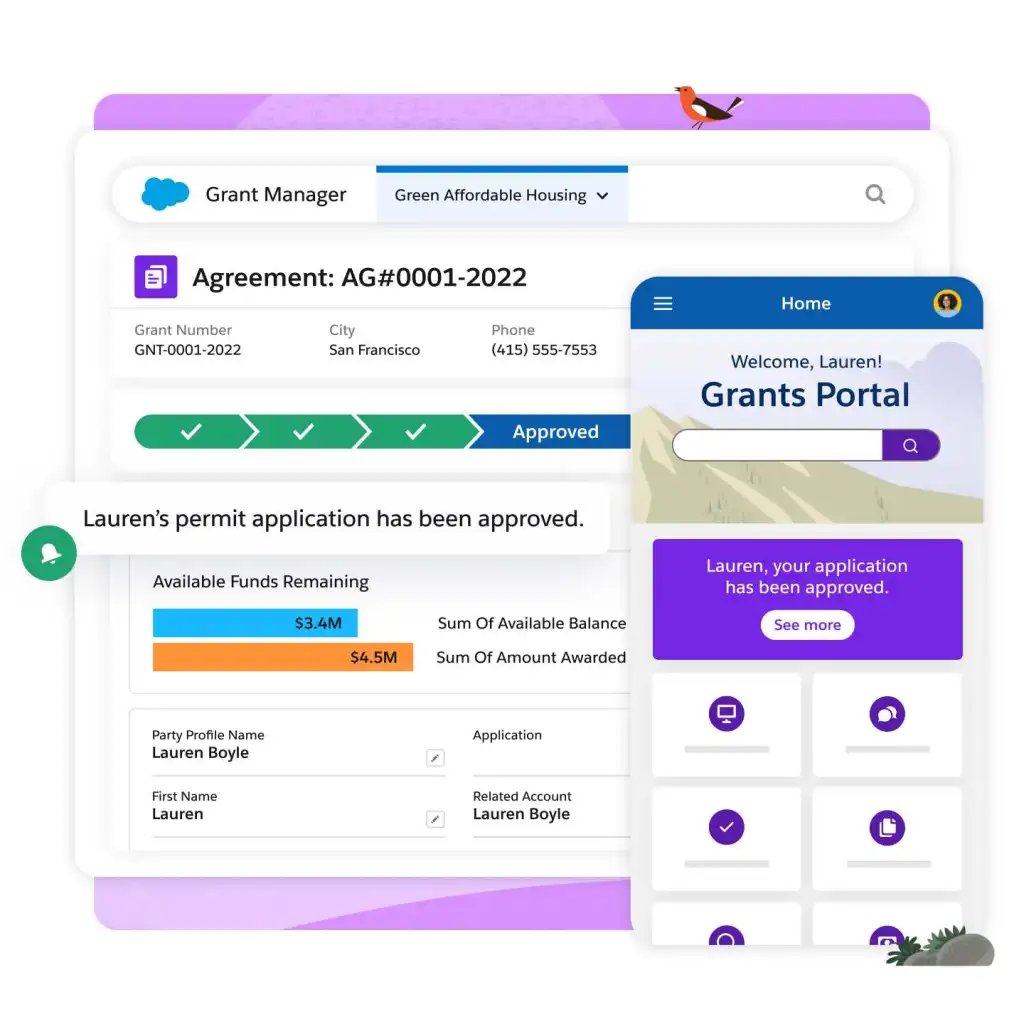
A modernized platform streamlines the entire lifecycle, using automated workflows to verify application details and alert reviewers immediately. It keeps compliance logs, financial records, and applicant profiles neatly organized in a single, secure space.
A strong real-world example is our partnership with BioMADE, a Department of Defense-funded manufacturing institute that distributes federal grants to advance domestic biomanufacturing. Their grant and contract processes were manual and decentralized, with no single source of truth and mounting pressure to scale across multiple member institutions while staying compliant. Working with BioMADE, we digitized the entire lifecycle, from proposal submission all the way through to executed contract, on Salesforce Public Sector Solutions integrated with DocuSign.
Source: https://www.salesforce.com/government/guided-tours/grants-management/
We redesigned their member portal so applicants can track submissions and collaborate in one place, and automated document generation, versioning, and e-signatures across the approval chain. The result was a shorter procurement cycle, lower administrative overhead, and real-time visibility for members and institutions, all on a compliant foundation built to support future AI-driven automation.
Enabling Seamless Cross-Agency Collaboration
True digital modernization also means breaking down the walls between departments serving the same communities. Housing, public health, and social services often interact with the same families but cannot easily share information.
With Salesforce Data 360, agencies can securely harmonize structured and unstructured data from separate databases in real time. It builds a unified profile of a family’s interactions without copying or moving files.
If a housing counselor approves a voucher, the update is instantly reflected on the secure profile, allowing caseworkers in other departments to coordinate support quickly. The result is better social outcomes while data privacy stays protected through role-based access controls.
Key Benefits Agencies Gain from Salesforce
By centralizing on a single platform, agencies see immediate improvements across their operations. First, they deliver services faster by automating repetitive manual tasks and document routing, which directly improves the citizen experience.
Second, automation relieves the administrative burden on public servants. Today, customer service representatives spend a significant portion of their day on manual paperwork rather than directly helping people. Streamlining that work frees staff to focus on high-priority cases.
Finally, leaders gain access to real-time analytics and dashboards, making it easier to spot service bottlenecks and make data-driven decisions. And with security controls built into the platform, maintaining strict compliance is far simpler.
Challenges Agencies Must Plan For
Any technology shift requires careful preparation. Moving decades of historical data out of legacy systems is a major undertaking that demands precise mapping and validation. Agencies must also configure consumer-side security controls, like multi-factor authentication and IP allowlisting, to keep the environment locked down.
Perhaps the most critical piece is change management. Organizational culture is consistently cited as one of the biggest barriers to scaling digital transformation. If employees are not trained and supported during the transition, even the best software will fail to gain adoption.
Finally, navigating complex government procurement regulations requires a clear, strategic approach from the very start.
How Vectr Solutions Empowers Your Digital Future
Government agencies need technology that keeps pace with citizen expectations while supporting security and compliance. Salesforce can modernize service delivery when it is built around your agency’s unique mission. But a successful deployment requires expert configuration, seamless integration, and strong workforce adoption.
This is where the right guide makes all the difference. At Vectr Solutions, we act as a dedicated partner to help government agencies modernize successfully. Rather than deploying rigid templates, our team designs custom, highly secure architectures tailored to your agency’s exact compliance and mission goals. We identify sensitive data, configure role-based sharing models, and secure the environment from day one.
To ensure your workforce is fully prepared, we use the proven, research-based Prosci change management methodology. This human-centered approach ensures your team gains the skills and confidence to operate, scale, and maintain the platform independently over the long haul. Whether you are consolidating legacy databases, streamlining case management, or securing government cloud environments, our senior-level architects ensure your technology is built to adapt and scale.
Reach out to our experts today to plan a modern, resilient path forward for your agency.