

For years, Salesforce automation promised a future where sales and service teams would spend less time clicking buttons and more time building relationships. In reality, most organizations never fully reached that vision.
Automation helped in some areas, but it also introduced new frustrations. Workflows broke. Data became unreliable. Teams stopped trusting the CRM. Instead of simplifying operations, many organizations ended up maintaining a fragile web of rules, triggers, approvals, and processes that required constant oversight.
Now AI copilots are changing the conversation.
Not because they replace humans, but because they finally make Salesforce automation more adaptable, contextual, and useful in the real world.
The Real Reason Salesforce Automation Struggled
Traditional Salesforce automation has always depended on one thing: perfectly structured data.
That sounds reasonable in theory. In practice, it rarely happens.
Most Salesforce environments deal with:
- Incomplete records
- Outdated fields
- Inconsistent formatting
- Duplicate data
- Low user adoption
- Processes that evolved faster than the CRM itself
Once bad data enters the system, downstream automation starts to fail.
A reminder gets triggered at the wrong time because a date field was never updated. A lead gets routed incorrectly because a territory value changed. A report becomes meaningless because sales reps stopped trusting the system and started working outside of it.
This is where many automation initiatives quietly stall out. The technology itself is not necessarily broken. The system becomes too rigid to handle how humans actually work.
This challenge is especially common in highly regulated environments where workflows are more complex and operational accuracy matters. Organizations in industries like aerospace, defense, manufacturing, and telecommunications often struggle to balance automation with the flexibility real-world teams need. That’s one reason many companies invest in more tailored Salesforce consulting services that align CRM automation with operational realities instead of relying entirely on out-of-the-box workflows.
AI Copilots Introduce Flexibility
AI copilots change the equation because they are not limited to strict “if this, then that” logic.
Traditional automation requires exact conditions:
- If field A equals X, trigger workflow B.
- If field C is blank, stop process D.
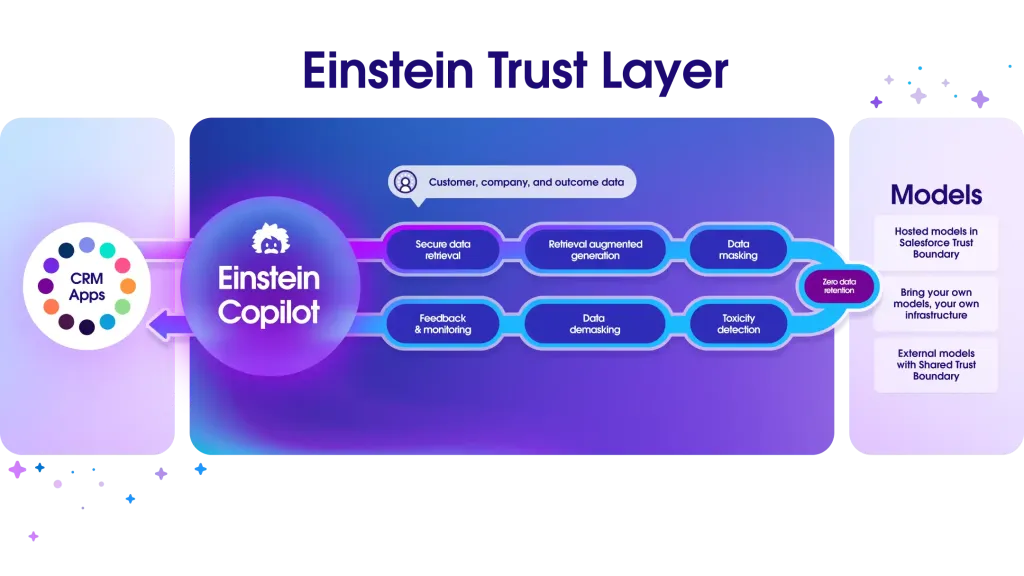
AI copilots operate differently. They can interpret context, work through incomplete information, and produce useful outputs even when the data is imperfect.
For example, a traditional workflow might completely fail if a field contains an unexpected value. A copilot can recognize the issue, ignore the bad input, and continue generating a useful summary or recommendation.
Source: https://www.salesforce.com/eu/artificial-intelligence/
That flexibility matters.
Instead of spending months building edge-case logic for every possible scenario, organizations can begin creating systems that behave more like experienced operators than rigid scripts.
For companies exploring platforms like Agentforce and AI-enabled CRM workflows, this is where modern Salesforce AI solutions are starting to create measurable operational improvements.
The Biggest Shift: Context Over Triggers
One of the biggest limitations of traditional CRM automation is that most processes operate independently.
Sales workflows, approvals, service queues, escalations, and notifications often exist as separate systems loosely stitched together. A small upstream change can create downstream failures that are difficult to diagnose.
AI copilots help bridge those gaps.
Rather than executing isolated tasks, copilots can work across workflows with a broader understanding of what is happening inside the business.
A service rep handling a support case, for example, no longer needs to manually jump between:
- customer history
- related cases
- account notes
- knowledge articles
- escalation policies
- internal documentation
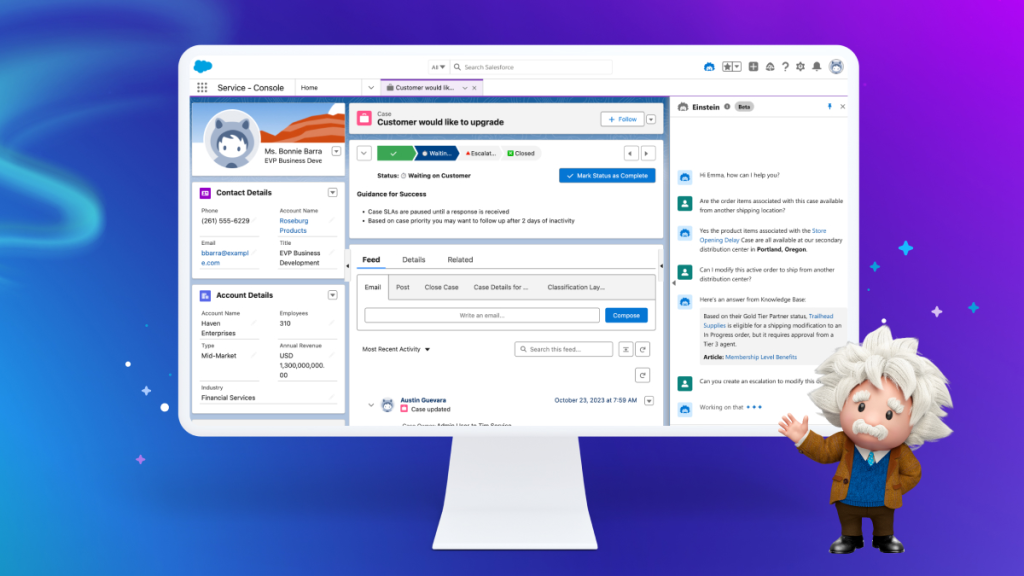
A copilot can surface relevant context in real time and guide the rep toward the next best action.
That does not eliminate the human role. It removes friction around the human role.
This is particularly valuable for organizations managing large operational ecosystems across multiple departments, vendors, or field teams. In sectors like manufacturing and telecommunications, disconnected workflows often create bottlenecks that slow down both customer service and internal decision-making.
AI Works Best as Augmentation, Not Replacement
There is a growing tendency to frame AI as a replacement technology. In practice, most organizations are finding the opposite.
The most effective AI implementations today are augmenting people, not removing them.
A good mental model is a “power suit” for sales and service teams.
Source: https://www.salesforce.com/au/news/stories/about-einstein-copilot/
AI copilots can:
- summarize opportunities
- capture meeting notes
- identify risks in pipeline data
- recommend follow-up actions
- surface relevant account history
- reduce manual CRM updates
- speed up repetitive administrative work
What they are not doing is replacing judgment, accountability, or relationship-building.
Those still belong to humans.
This distinction matters because businesses that push too aggressively toward full replacement often create new operational risks.
Teams can become overly reliant on AI-generated outputs without validating them. Recommendations get accepted without critical review. In technical environments, this can lead to serious downstream issues.
AI is incredibly effective at processing information quickly. It is far less effective at understanding nuance, accountability, and business consequences the way humans do.
That human oversight becomes even more important in industries with compliance requirements, sensitive operational data, or complex approval chains. Organizations in the defense and aerospace sector often need AI-enabled workflows that improve speed and visibility while still maintaining strict governance and accountability.
Why Human-Centered Service Still Matters
This becomes especially important in customer service environments.
Many organizations have tried to fully automate support experiences through bots and self-service systems. Customers often push back immediately.
People do not just want fast answers. They want to feel understood.
That becomes even more important in industries with:
- complex products
- technical troubleshooting
- regulated workflows
- high-value customer relationships
- nuanced operational requirements
A customer calling about a complicated manufacturing issue or government compliance concern does not want to navigate a generic chatbot flow. They want a knowledgeable person who can interpret context, ask questions, and adapt in real time.
AI copilots can absolutely help service teams move faster and work smarter. But the human element remains critical.
The future of service is not human or AI. It is humans supported by AI.Organizations improving customer experience often combine AI copilots with broader Salesforce Service Cloud and RevOps strategies to reduce operational friction without sacrificing the human side of support.
What Organizations Should Focus On Now
The companies seeing the most success with AI copilots are not treating them like magic automation layers.
They are focusing on:
- improving data quality
- simplifying workflows
- reducing operational friction
- giving teams better visibility
- introducing AI in controlled, high-value use cases
The goal should not be to remove humans from Salesforce.
The goal should be to remove unnecessary manual work so humans can spend more time on the decisions, conversations, and relationships that actually move the business forward.
That is where AI copilots are delivering real value today.
And for many organizations, it is the first time the original promise of Salesforce automation actually feels achievable.