

Key Takeaways
- Salesforce no longer sells CPQ to new customers, and new features now go to Revenue Cloud.
- A&D and GovCon teams tend to hit CPQ’s limits first.
- Moving to Revenue Cloud means rebuilding your quoting process, so plan it like a new implementation.
- Settle where your data will live and who can see it before migration work starts.
In March 2025, Salesforce moved CPQ to end of sale. That means no new customers can buy it, but existing customers can still renew, add users, and get support. What changed is where Salesforce puts its development work. New features now go to Revenue Cloud, which Salesforce also markets as Agentforce Revenue Management.
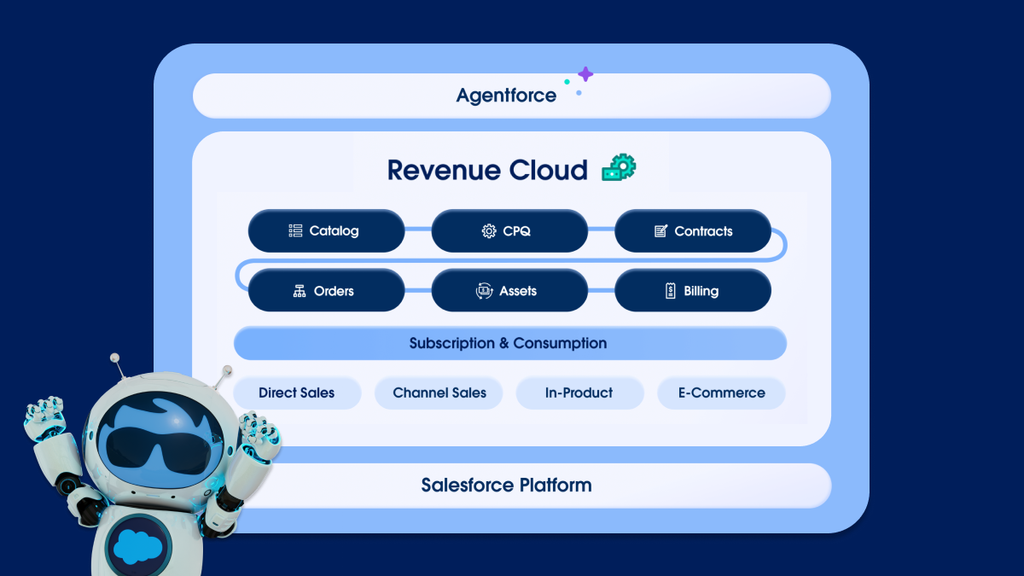
Source: https://www.salesforce.com/news/stories/agentforce-for-revenue-announcement/
There’s no forced migration date, so the real question is whether CPQ still fits where your business is headed. For aerospace and defense manufacturers and government contractors, that question tends to come up sooner. Their quoting has to handle complex configurations, contract-specific pricing, export-controlled data, and approvals that hold up in an audit. Over time, CPQ orgs in these industries pile up custom code and workarounds to cover all of it, a form of technical debt that makes the decision more pressing.
We see this regularly in the Salesforce solutions we build for aerospace and defense contractors. Here are four signs it’s time to move. For a feature-by-feature comparison, see our breakdown of Salesforce CPQ vs Revenue Cloud.
Your Pricing Logic Lives in Custom Code
Most mature CPQ orgs rely on price rules and custom scripts that only one or two people fully understand. In A&D and GovCon, that code often holds contract-specific discounts, escalation clauses, and customer price lists. When the person who wrote it leaves, every pricing change becomes a risk.
Revenue Cloud handles pricing through pricing procedures, which are step-by-step rules an admin can read and adjust in Salesforce setup. Moving that logic out of code is one of the most direct ways to fix Salesforce technical debt in a quoting org.
Your Product Catalog Has Outgrown Bundles
CPQ models products as SKUs, or individual part numbers, grouped into bundles. When one system ships in dozens of configurations with different spares and sustainment options, the number of SKUs multiplies fast, and so does the work to keep them accurate.
Revenue Cloud uses an attribute-based catalog. A single product carries attributes like size, power rating, or kit contents, so you don’t need a separate part number for every variant. A constraint-based configurator then checks which combinations are valid, so sellers can’t quote something engineering would never build.
Quotes Don’t Flow Into Contracts and Orders
Government contractors handle contract modifications, option periods, and renewals constantly. If your team retypes quote details into a contract record, an ERP like Deltek Costpoint, or a spreadsheet to track what the customer owns, those handoffs are where errors creep in.
Revenue Cloud keeps quotes, contracts, orders, and assets (records of what the customer bought and still has) on the same data model. When a contract changes mid-term, the amendment ties back to that asset. It also supports usage-based pricing and partner channels, which matters if you sell aftermarket parts through distributors or price sustainment work by usage.
Leadership Wants AI in Quoting, With Guardrails
For a regulated company, the question about AI is what an agent is allowed to do, such as suggest a discount or route an approval, and how each action stays inside your rules and leaves a record. CPQ’s design makes that hard without custom development for every step.
Revenue Cloud exposes pricing, quoting, and approvals as governed services that Agentforce can call within limits you set. We wrote about AI-generated quotes for complex engineering products back in 2023, and the lesson still holds: AI only helps when the pricing data and rules underneath it are clean.
What the Migration Involves
CPQ is a managed package, meaning a separate application installed on top of Salesforce. Revenue Cloud is built into the core platform with a different data model, so CPQ records, price rules, and scripts don’t carry over one-to-one. In the lift and shift vs replatforming debate, this lands firmly on replatforming: you rebuild the quoting process for the new system instead of copying years of workarounds into it.
There’s no standard timeline. How long it takes depends on how much custom code and how many integrations your CPQ org has, which is why we start with an inventory. The work starts with the product catalog and pricing, then moves to quote templates, approvals, and how active contracts carry over. Integrations to ERPs like Deltek Costpoint or SAP need their own plan, and following Salesforce integration architecture best practices, such as connecting through MuleSoft, saves rework later. For Government Cloud orgs, check the integration tool’s authorization too: MuleSoft Government Cloud has its own FedRAMP Moderate authorization, separate from Salesforce’s FedRAMP High boundary.
The piece teams most often underestimate is people. A new quoting screen changes the daily routine for sellers, deal desk, and contracts staff, which is why we use a Prosci-based change management approach for every Salesforce rollout.
Security Questions to Answer First
For defense manufacturers and government contractors, a CPQ migration also moves sensitive data. Quotes can include controlled unclassified information (CUI) and technical details covered by ITAR export rules, so your security team needs a seat at the table before you commit.
Start with where the org will run: Revenue Cloud isn’t available in Government Cloud Plus Defense, so if that’s your environment, it’s a hard stop worth knowing before anything else. In Government Cloud Plus, Salesforce lists Revenue Cloud as interoperable but not authorized, which means it sits outside the FedRAMP High boundary and using it is a risk decision your security team has to make. Beyond that, three questions deserve an early answer: whether that risk is acceptable for your contracts, where ITAR data shows up in your quotes and attachments, and whether your quoting system falls inside your CMMC assessment boundary.
How Vectr Helps
Vectr works mainly with regulated organizations, including aerospace and defense manufacturers and government contractors, and our team holds 85+ Salesforce certifications. We run every CPQ migration through the same four-phase delivery methodology.
Hover over or tap a phase to see what happens in it.
Discovery
Setup
Extend
Enhance
Discovery. We inventory every price rule, script, bundle, approval, and integration in your CPQ org, and map where controlled data appears in the quoting process. This is also where we confirm which Revenue Cloud features your Salesforce environment supports.
Setup. We design the simplified catalog and pricing first, then stand up the highest-value parts of Revenue Cloud so sellers see results early. Migration work happens in controlled environments, with access limited to the people who need it.
Extend. We connect the surrounding systems, including your ERP through MuleSoft, and bring contracts, orders, and assets into the new model. Sellers and deal desk staff test real quotes before go-live.
Enhance. After launch, our managed services team keeps Revenue Cloud current as your products, pricing, and contracts change, and trains your internal team to run it day to day.
We’ve done this kind of secure work before. For an aerospace and space propulsion manufacturer, we built an ITAR-compliant Salesforce Government Cloud environment and migrated their existing data without disrupting operations.
Start With a Readiness Check
CPQ isn’t going away this year, which gives you room to plan the move on your own terms.
If a renewal, an acquisition, or a Government Cloud move is already on the calendar, that’s a natural time to fold in quoting.
Not sure where your org stands? Speak to an expert about a CPQ assessment!