
When an emergency strikes, every second matters. Public safety agencies, including police, fire, and EMS departments, constantly navigate an increasingly complex landscape of incidents that demand immediate, highly coordinated actions. Yet, during large-scale events or high-stakes crisis scenarios, response efforts can be bogged down by a common hurdle: disconnected technology.
When dispatch software, field communications, and historical data systems cannot talk to each other, critical updates get trapped in silos. Field responders are left waiting for vital context, command centers struggle to get a clear picture of the situation, and multi-agency collaboration becomes clunky and fragmented. The harder challenge is that in government, those systems can’t simply be wired together with off-the-shelf plugins. They have to be integrated inside strict security and compliance boundaries. Getting that integration right, without breaking compliance, is where response times are won or lost.
Moving From Siloed Tools to Connected Ecosystems
Traditional public safety operations often rely on fragmented software packages that serve narrow functions. While individual tools might manage records or dispatch teams effectively on their own, the lack of integration introduces a dangerous lag during active emergencies. True situational awareness requires a unified platform where information flows automatically between dispatchers, command staff, and boots on the ground.
By transitioning away from isolated tools and moving toward a fully connected ecosystem, agencies gain real-time visibility across teams and departments. When communication infrastructure, historical databases, and tracking tools operate as a single system, it removes the guesswork from incident response. Leadership can see where resources are, what field teams are experiencing, and how an event is unfolding, all from a single pane of glass.
Bringing People and Data Together in Real Time
Achieving this level of operational agility requires a blend of collaboration, case management, and data visualization. Modern platforms like Slack, Salesforce, and Tableau together with Salesforce Public Sector Solutions provide a powerful foundation for public safety technology, working in tandem to streamline operations from the initial emergency call to the final incident report.
Communication is the pulse of any incident response. Instead of relying on fragmented radio channels or buried email threads, agencies use Slack to centralize messaging into dedicated, incident-specific channels. This allows cross-agency partners, specialized response units, and dispatchers to exchange instant messages, upload field photos, and share secure updates simultaneously.
Behind the scenes, Salesforce serves as the central engine for incident and case management. It functions as a single source of truth, storing crucial operational data, tracking resources, and managing ongoing workflows. When an event occurs, Salesforce helps automate routine notifications and updates, ensuring that documentation remains accurate and accountability is maintained without forcing responders to fill out tedious paperwork mid-crisis.
To make sense of the massive amount of information flowing through these systems, Tableau layers visual analytics on top of the data. During an active incident, command centers can monitor near-real-time dashboards, while Tableau Pulse surfaces threshold breaches and anomalies, like a spike in call volume or a resource dropping below a safe level, without anyone having to watch a screen. This data-driven visibility empowers leadership to make rapid, informed decisions about where to deploy personnel and how to adapt to changing conditions on the ground.
Connecting the Ecosystem for Maximum Impact
The true power of these tools emerges when they are seamlessly integrated. Rather than requiring personnel to jump between three different applications, a unified system shares data across all platforms automatically. A critical status update logged in Salesforce can trigger an automated alert in a dedicated Slack channel, while a Tableau dashboard refreshes to reflect the change for command staff.
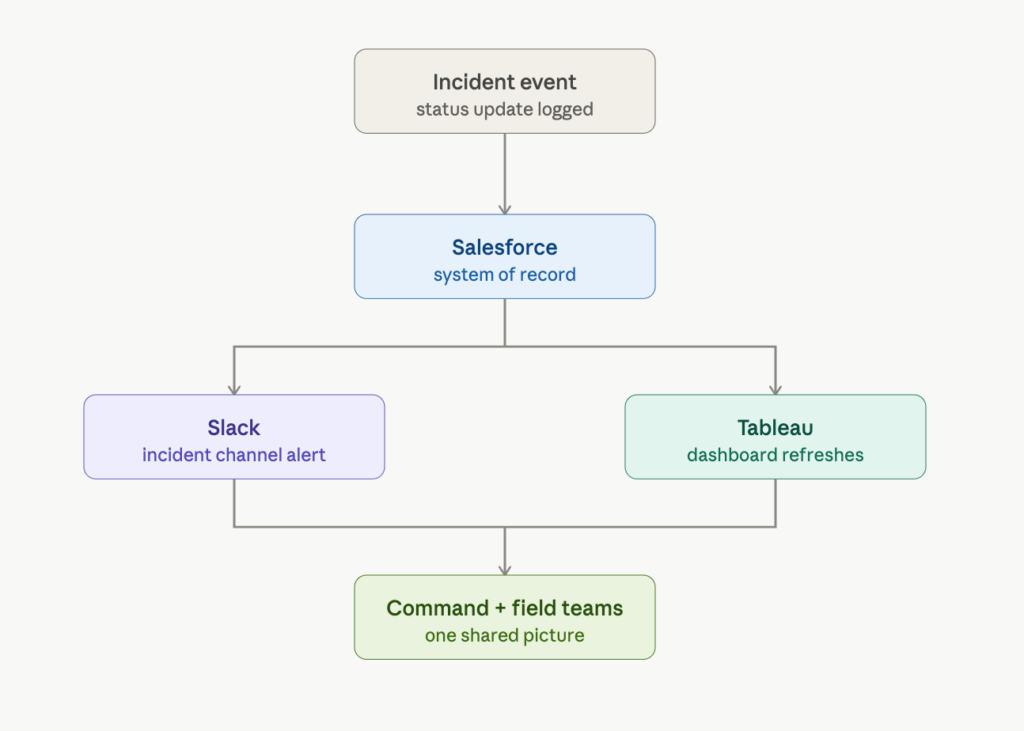
(One update, three systems, zero manual re-entry.)
One important nuance for government agencies: in secure environments, the standard out-of-the-box “Salesforce for Slack” marketplace apps are not supported. Connecting a system of record like Salesforce Government Cloud to GovSlack requires a purpose-built, compliant API bridge using custom apps and webhooks. Done right, that bridge delivers the same automated, cross-platform flow while keeping every message and record inside the compliance boundary.
This level of workflow automation ensures that everyone, from leadership in the command center to teams in the field, operates with the exact same information. By replacing manual updates with automated data sharing, agencies eliminate operational blind spots and shave precious minutes off their response times.
Whether managing daily coordination, navigating a major natural disaster, or tracking personnel and assets across a multi-jurisdictional event, an integrated ecosystem transforms how agencies show up for their communities. It replaces chaotic, fragmented communication with structured, automated, and visible operational workflows.
Navigating Implementation and Compliance
Deploying an integrated ecosystem within the public sector requires careful planning. Public safety leaders must evaluate how new platforms will interface with existing legacy systems, such as computer-aided dispatch software. Furthermore, protecting sensitive community and incident data is paramount, meaning any digital solution must adhere to strict government security and compliance standards including frameworks such as FedRAMP High, DoD Impact Levels, ITAR, and CMMC where applicable.
Beyond the technology itself, team adoption and scalability are critical factors for long-term success. Agencies need a deployment strategy that includes intuitive training so personnel can confidently navigate the software under pressure. Ensuring the platform can scale to handle sudden spikes in usage during regional emergencies is equally vital.
This balance between complex security requirements and user-friendly design is central to how we approach public sector modernization. For a U.S. defense organization, we stood up a fully FedRAMP-compliant case management system in just 10 weeks, complete with automated routing, SLA tracking, and a self-service portal, proving that secure, mission-critical platforms don’t have to take years to deploy. That same philosophy guided our work on the BioMADE grantmaking program, where we used Salesforce Grantmaking, OmniStudio, and DocuSign to build a single source of truth that gave applicants real-time visibility into their requests and staff instant access to status updates, all without heavy custom development. Public safety integration requires that same meticulous attention to detail: systems that are compliant, resilient, and simple for teams to use when stakes are high.
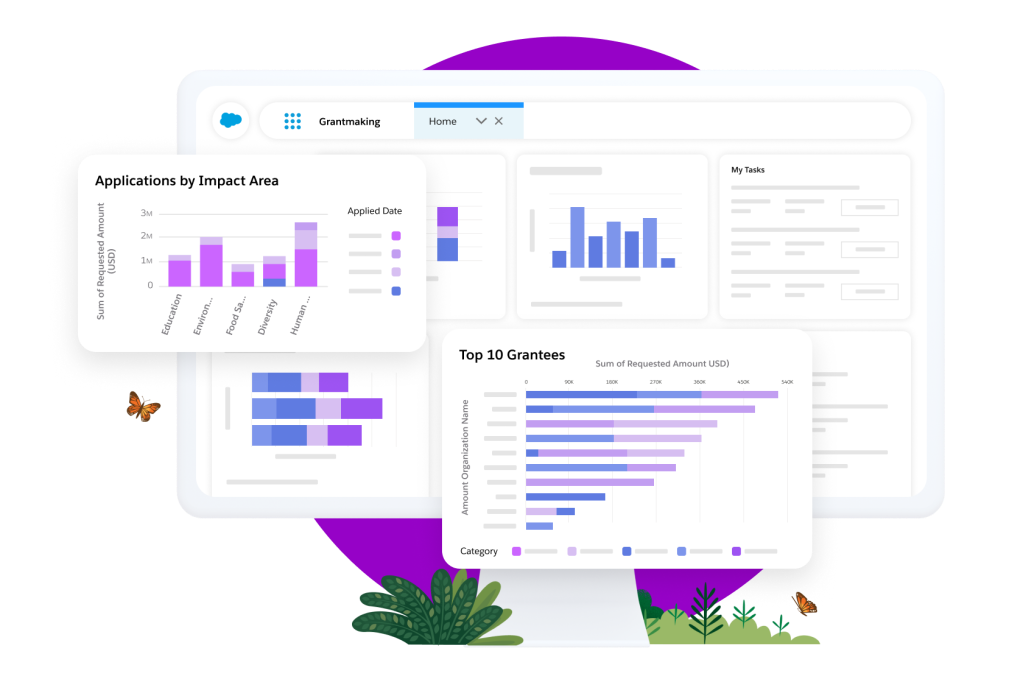
Source: https://www.salesforce.com/nonprofit/grantmaking-software/
Partnering for Operational Excellence
Building a connected, secure, and mission-ready technology ecosystem takes deep technical expertise and a thorough understanding of public sector workflows. At Vectr Solutions, we specialize in helping state and local organizations navigate these complex digital transitions.
Our team possesses deep knowledge of the Salesforce ecosystem, including Public Sector Solutions, Tableau, Tableau Pulse, Slack and GovSlack, and MuleSoft, allowing us to engineer tailored, compliant integrations that align with your unique operational workflows. We focus on delivering end-to-end implementation and continuous support, and on making your teams self-sufficient, so your technology serves as an asset rather than a hurdle during critical moments.
Transform Your Emergency Response Capabilities
Modern emergency response demands connected systems, real-time communication, and actionable insights built to survive a compliance audit. Vectr Solutions helps public safety agencies integrate Slack, Tableau, and Salesforce to streamline operations and improve outcomes when it matters most.