
Most state and local agencies aren’t choosing to run on legacy systems. They’re just not choosing to stop. Every renewal cycle, every point release, every emergency patch becomes another reason modernization gets pushed to next year’s budget.

That inertia carries a real cost. By some industry estimates, public sector agencies spend as much as 80% of their technology budgets just keeping legacy systems running, starving new digital projects of the funding they need.
The bigger problem is operational, not just financial. Departments running isolated databases means data gets trapped in silos, staff fall back on manual re-entry and physical routing, and constituents end up resubmitting the same paperwork to multiple offices, a silent tax paid in staff hours and processing delays.
Why Modernization Is a Strategic Priority
Living with these operational bottlenecks is no longer sustainable. That is why modernization has shifted from a back-burner IT project to a top-tier strategic priority. With state and local budgets normalizing and public expectations rising, leaders must prove the value of every single technology dollar they spend .
Compliance is adding urgency. The U.S. Department of Justice has set web and mobile accessibility standards for state and local governments under Title II of the ADA, requiring conformance with WCAG 2.1 Level AA. The compliance deadlines were pushed back in April 2026 to April 2027 for governments serving 50,000 or more people, and to April 2028 for smaller entities. Accessibility has become a real priority for state technology leaders, though NASCIO’s guidance shows how far many states still have to go, with roughly half reporting no dedicated funding for the work.
Security is another pressure point. Older database systems were never built to defend against modern, automated cyber threats, and moving to secure infrastructure is the surest way for agencies to protect sensitive constituent data.
How Salesforce Transforms State & Local Operations
So how do government organizations handle tight budgets and complex regulations without starting over? The answer is rarely a risky, expensive “rip-and-replace” of core systems. Instead, Salesforce Public Sector Solutions can act as a secure, flexible layer that connects the tools you already have.
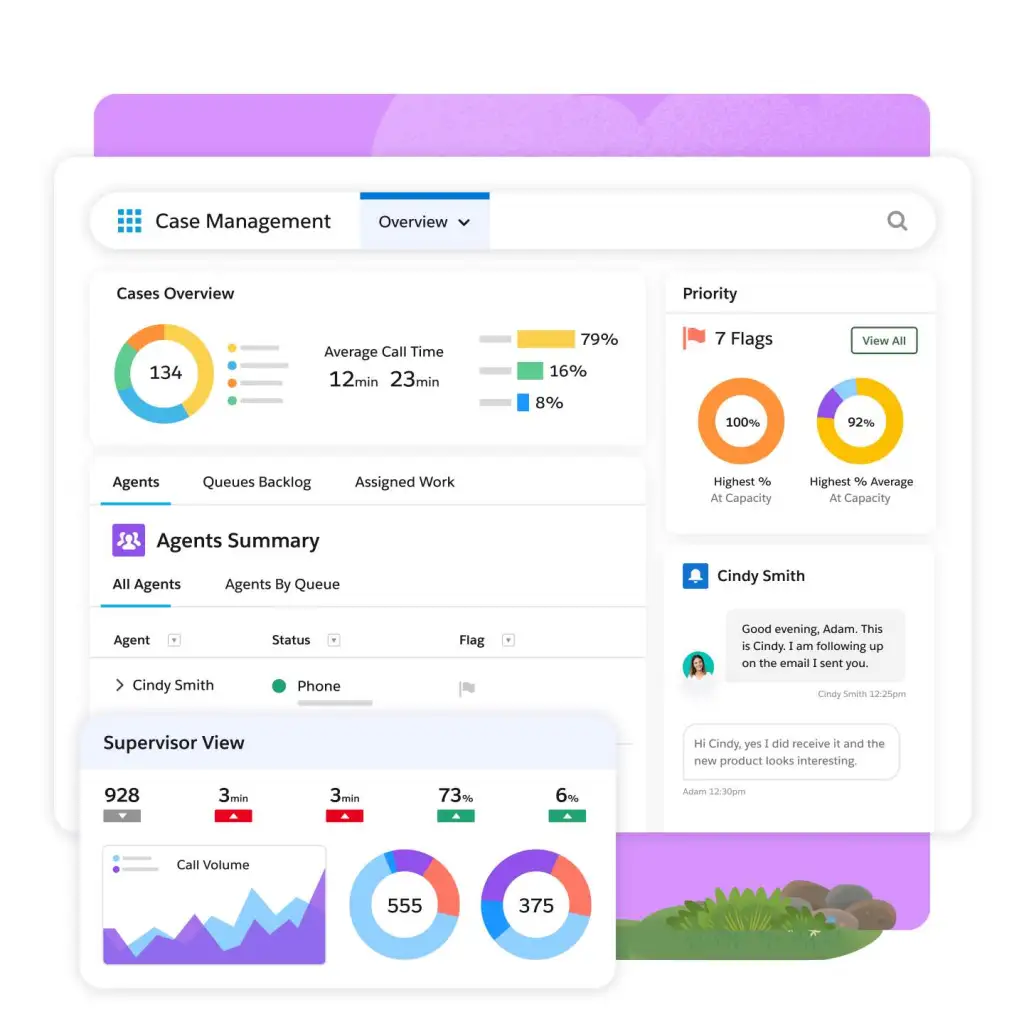
Source: https://www.salesforce.com/government/solutions/
By tying those systems together, Salesforce gives agencies a 360-degree view of their operations and their constituents. Built-in capabilities like OmniStudio and the Business Rules Engine let teams launch guided digital forms and automate complex decisions, moving work off paper and into cloud-native workflows that scale as the community grows.
From Disconnected Systems to Connected Workflows
Real transformation takes more than new software. It means bridging the gap between disconnected databases and connected workflows.
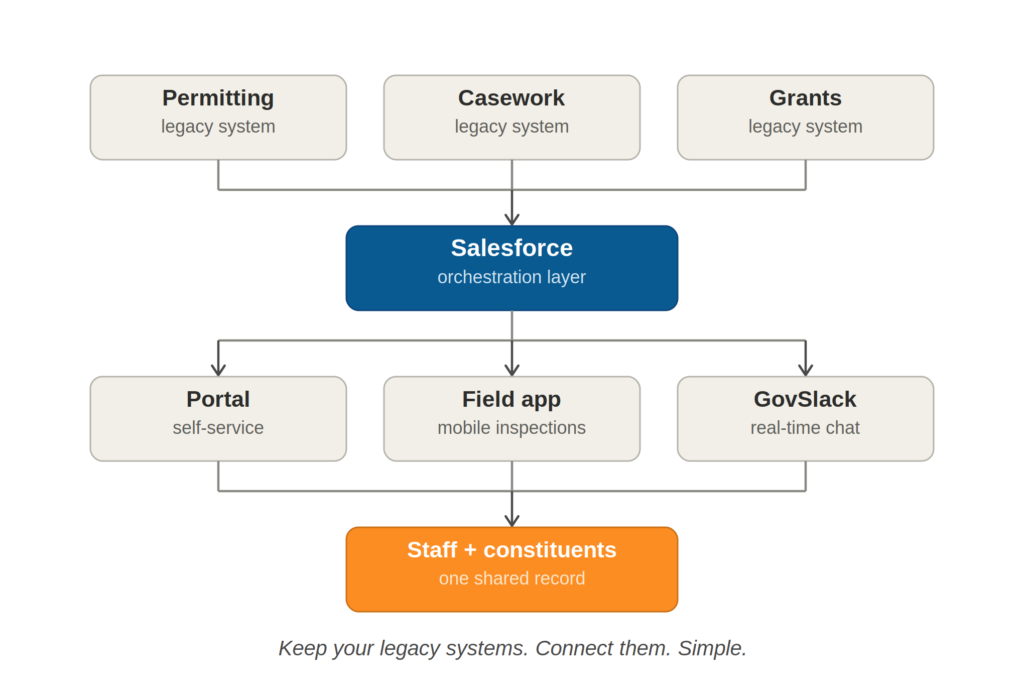
With modern, API-led integration, agencies can safely unlock and share data across departments without destabilizing their core systems. This is not about adding one more portal for staff to check. When it works, the platform becomes an operational backbone that runs behind the scenes. Salesforce orchestrates the data, identity, and workflow while people work through the tools they already use, whether that is a self-service portal, a mobile field app, or a conversation in Slack. Constituents stop submitting the same paperwork to multiple offices, and staff work from one shared, trustworthy record instead of chasing updates across systems.
Key Use Cases for Salesforce in State & Local Agencies
When you connect these workflows, the impact is felt across every area of public service.
- Licensing, Permitting, and Inspections: Salesforce automates applications, tracking, and renewals. When field work is required, inspectors can use mobile devices and Salesforce Field Service, often paired with GIS maps, to view checklists, look up regulatory codes, and capture digital signatures on-site, which removes back-office data re-entry.
- Constituent Services and Case Management: This is the kind of work we do every day. When Vectr Solutions partnered with the statewide Keep Arkansas Beautiful Commission, the organization was running volunteer coordination, event participation, inventory tracking, and daily operations across a patchwork of manual tools and disconnected systems. Rather than chasing new features first, we built a scalable operational foundation in Salesforce, consolidating volunteer management, events, and inventory into a single system so staff finally had one connected view of their programs.
- Grants and Program Management: Salesforce simplifies the grant lifecycle by tracking proposals, automating eligibility checks, and managing disbursements. For the BioMADE grantmaking program, we used Salesforce Grantmaking, OmniStudio, and DocuSign to build a FedRAMP-compliant single source of truth, giving applicants a clear view of their requests and staff real-time access to application content and status, without heavy custom development or long timelines.
Data Integration and Real-Time Insights
Once systems are talking to each other and surfacing real-time data, automation becomes the next lever. In a sector facing serious staffing shortages, it helps stretched teams do more by routing approvals, sending compliance alerts, and assigning casework, which frees people to focus on direct public service.
But there’s a bigger reason this integration work matters right now: it’s the same foundation AI needs to function safely in government. An agent, whether it’s answering a constituent question, triaging a case, or flagging an anomaly, is only as good as the data it can see. If casework, permitting, and grants data are still sitting in disconnected systems, an AI layer on top just automates the guesswork faster. Connected, trustworthy data isn’t a nice-to-have before you adopt Agentforce or any agentic tooling, it’s the prerequisite. Agencies that treat integration as the “boring” infrastructure step are actually doing the AI readiness work, whether or not AI is on the roadmap yet.
That readiness has a governance dimension automation for other sectors often skips. In government, automation has to be explainable. You cannot automate a denial or a rejection with a black-box model. The logic has to be deterministic and transparent so an agency can always show the reasoning behind a decision, whether the audience is a constituent, an auditor, or a court. When AI enters the workflow through Agentforce or scoring agents in the field, that auditability doesn’t relax. If anything, it’s the test that determines whether an agency can respond to an OIG inquiry or a public records request about how a decision got made. The agencies best positioned to adopt AI responsibly won’t be the ones who moved fastest, they’ll be the ones who connected their data first.
Watch the Budget: Consumption Pricing Is the New Risk
Modernization is no longer only a technical decision. It is increasingly a fiscal one. As Salesforce moves toward consumption-based pricing and credits, agencies working within fixed, biennial budgets face a new risk. A viral spike in traffic can drain a year’s technology budget in days. That is why we help clients build a budget buffer, architecting guardrails and monitoring credit burn rate like a utility bill so innovation does not turn into a runaway invoice.
Security, Compliance, and Scalability
Managing sensitive constituent data means security and compliance can never be an afterthought. Salesforce Government Cloud Plus holds FedRAMP High authorization and a CJIS attestation, built for exactly this purpose. It is worth noting that CJIS compliance is ultimately confirmed by a CJIS Systems Officer in each jurisdiction, so FedRAMP authorization alone does not automatically satisfy it. For teams sharing sensitive information in real time, GovSlack extends that same compliance posture to everyday collaboration.
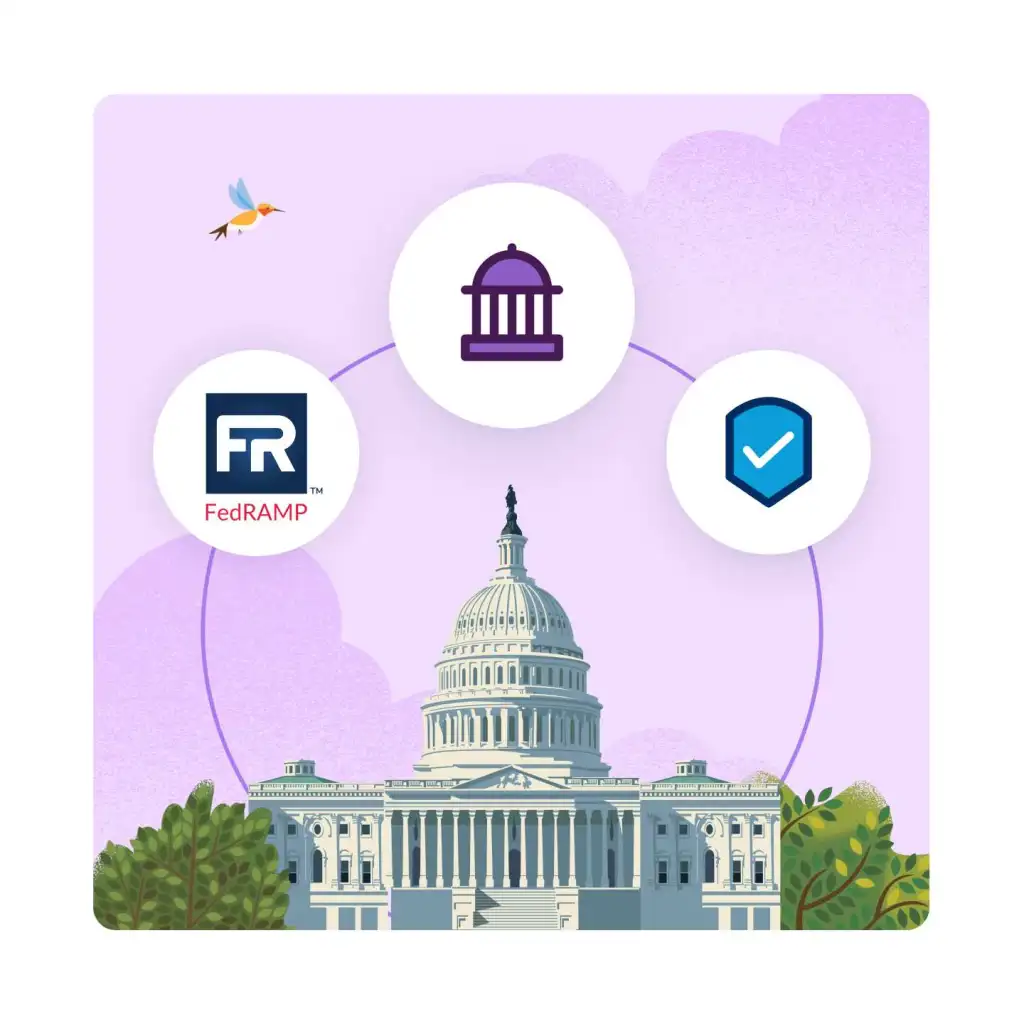
Source: https://www.salesforce.com/government/cloud/
The cloud-native design also brings elastic scalability. Whether an agency is handling a seasonal rush or responding to a sudden natural disaster, the platform absorbs traffic spikes without crashing.
Overcoming Common Modernization Challenges
Even with the benefits clear, starting can feel overwhelming. Complex databases, tight budgets, and resistance to change all stall planning.
The way through is a phased approach. You do not have to replace your entire stack overnight. By using Salesforce as an orchestration layer over your existing databases, you can keep those systems running while connecting and migrating processes step by step, which lowers risk and builds trust along the way.
Why Partner with Vectr Solutions
The right partner makes the difference. Navigating the procurement, compliance, and budget cycles of the public sector takes deep, specialized experience.
Vectr Solutions brings hands-on public sector experience and technical Salesforce expertise across the full ecosystem, including Public Sector Solutions, Government Cloud, MuleSoft, Tableau, Data 360, Agentforce, and GovSlack. We guide you through the whole journey, from planning and data migration to launch and ongoing support, and we focus on leaving your team self-sufficient. Partner with us to eliminate technical debt, connect your workflows, and deliver the modern services your constituents expect.
Modernize Your Government Operations with Confidence
Legacy systems do not have to limit your agency’s potential. Vectr Solutions helps state and local organizations move to connected, efficient workflows using Salesforce. Partner with experts who understand public sector challenges and deliver scalable, future-ready solutions.