
Key Takeaways
- Most local agencies don’t lack technology. They have too many tools that don’t talk to each other.
- Salesforce can bring constituent requests, permits, grants, and emergency coordination into one shared system.
- The platform pays off only when data, integrations, and staff training are planned before the build.
- Vectr sizes the work for small local teams, with architect-led implementation, integrations with the systems you already have, change management, and support after launch.
Ask a resident how many phone calls it took to get a pothole fixed or a permit approved, and you’ll learn a lot about how their local government runs behind the scenes. Public works has one system. Code enforcement has another. Finance tracks grants in a spreadsheet that two people understand. Each tool made sense when it was bought. Together, they make it hard for staff to see the full picture and harder for residents to get a straight answer.

Cities and counties deal with this with far fewer people than a state agency. One small IT team may support every office from the clerk to the sheriff, and a public works director may also run the fleet. When systems don’t connect, the extra work lands on that same small team.
We see this pattern constantly in our public sector work. For most cities and counties, the question is no longer whether a modern platform can handle a service request or a permit. The real question is whether the agency sets that platform up as one connected system or ends up with one more tool that doesn’t connect to anything.
That’s where Salesforce for local government comes in. It’s also where many implementations go sideways. This guide explains what Salesforce does for cities, counties, and municipal agencies, defines the terms you’ll hear along the way, and shows how Vectr helps local teams put it in place.
Why Local Government Agencies Are Turning to Salesforce
Local governments rarely plan technology all at once. A department gets budget, buys a tool that solves its immediate problem, and moves on. Ten years later, the agency has a dozen separate databases, each with its own version of a resident’s name, address, and history.
Staff feel this every day. A clerk retypes information from one screen into another. The industry calls this “swivel chair” work, because you’re turning back and forth between systems. Handoffs happen over email. Nobody can quickly answer a question like “how many open requests do we have on Washington Street?”
In government, a “customer” is the constituent: the resident, business owner, contractor, or nonprofit working with your agency. A Salesforce government CRM gives every department a shared record for each constituent. Every call, request, permit, and payment lives in one place instead of five.
Salesforce also offers Public Sector Solutions, a set of prebuilt tools for government work like case management, permitting, and grants. (Our breakdown of what Salesforce Public Sector Solutions can do covers each one.) These tools all share the same foundation. That means Salesforce local government solutions can start in one department and expand to others without starting over.
Constituent Service and Case Management
In Salesforce, a “case” is any request that needs follow-up: a missed trash pickup, a noise complaint, a request for rental assistance. With Salesforce constituent service management, every request becomes a trackable case with an owner, a status, and a due date. That holds whether it arrives by phone, web form, email, or at the front counter.
The biggest change comes from routing, the rules that decide who gets each case. There’s no longer a shared inbox that someone checks when they have time. A broken streetlight goes straight to public works. An unpermitted fence goes to code enforcement. If a case moves between departments, its full history moves with it, so nobody has to call the resident back and start from scratch.

Field crews get the same connected record. A public works crew opens the request on a mobile device, sees the location, photos, and past work at that address, and closes it out on site. The resident gets an update when the job is done, and nobody types up field notes back at the office. With Salesforce Field Service, work can also be scheduled by location, skills, and availability, so the right crew goes out the first time.
AI agents can take on part of the intake, too. Agentforce can summarize a long voicemail or email, suggest which department owns the request, and draft a reply for staff to review before it goes out.
Permitting and Licensing Workflows
A single home addition might need sign-off from zoning, building, fire, and engineering before an inspector visits the site. When that process runs on paper, the file sits on one desk at a time, and the applicant has no idea where it stands.
Salesforce permitting software moves that process into a portal: a secure website where applicants log in, upload documents, pay fees, and schedule inspections. Inside the agency, reviewers from different departments can work on the same application at the same time instead of passing a folder down the hall. Automated notifications move things forward. When fire signs off, for example, the building reviewer gets an alert right away. Applicants and staff see the same status at every step.
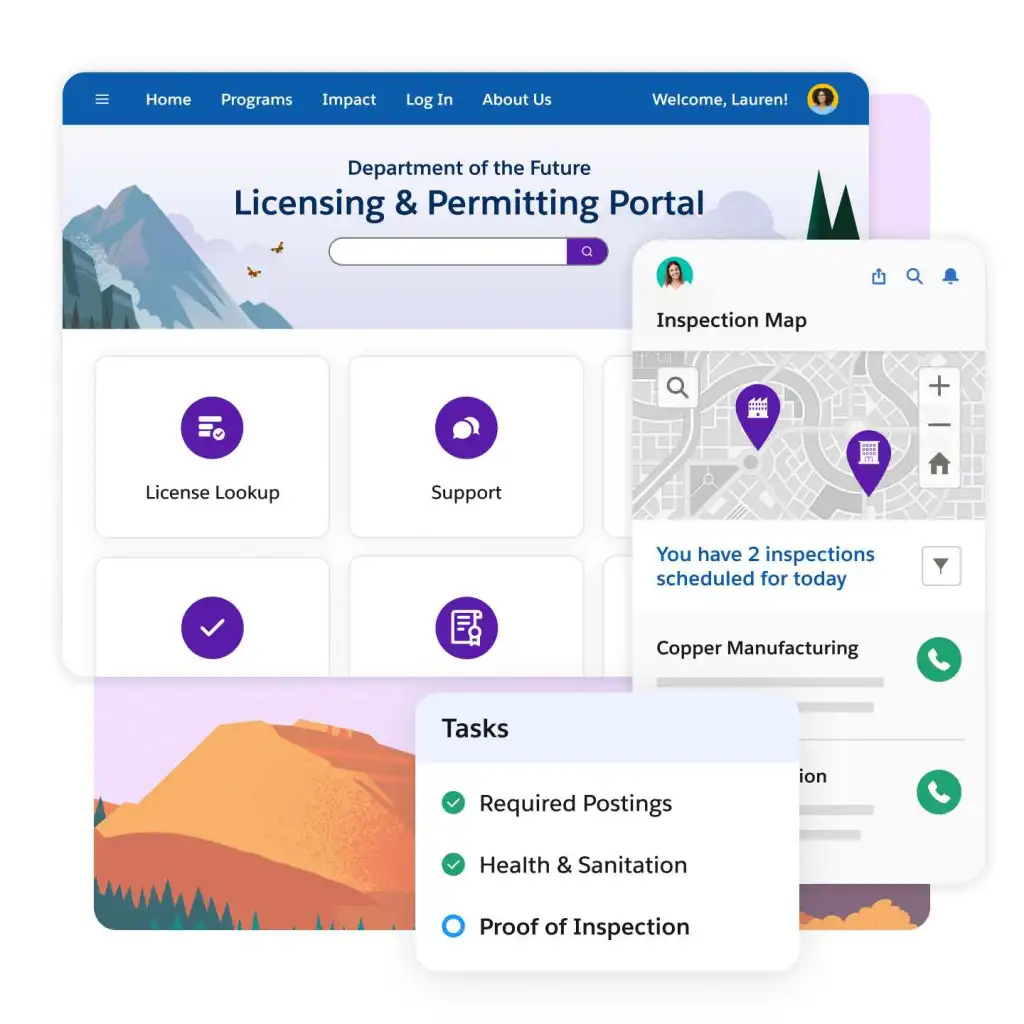
Source: https://www.salesforce.com/government/guided-tours/license-and-permits-management/
The same setup works for business licenses, short-term rental registrations, special event permits, and contractor licensing. Renewal reminders go out automatically, fees are paid online, and inspectors see the day’s schedule on a mobile device with each application attached. When a rule changes, such as a new fee or an added review step, staff can update the process without starting a new project.
Grants Administration for Local Government
Cities and counties often manage several funding sources at once: state infrastructure dollars, federal disaster recovery funds, public health grants. Each comes with its own eligibility rules, spending limits, and reporting deadlines. Post-award reporting, the reports that prove how awarded money was spent, is where spreadsheets tend to break down. A missing document or a mismatched number can put future funding at risk.
Salesforce grants management for local government keeps intake, review, awards, payments, and reporting in one system. It also creates an audit trail, an automatic record of who changed what and when, so audits stop being a scramble.
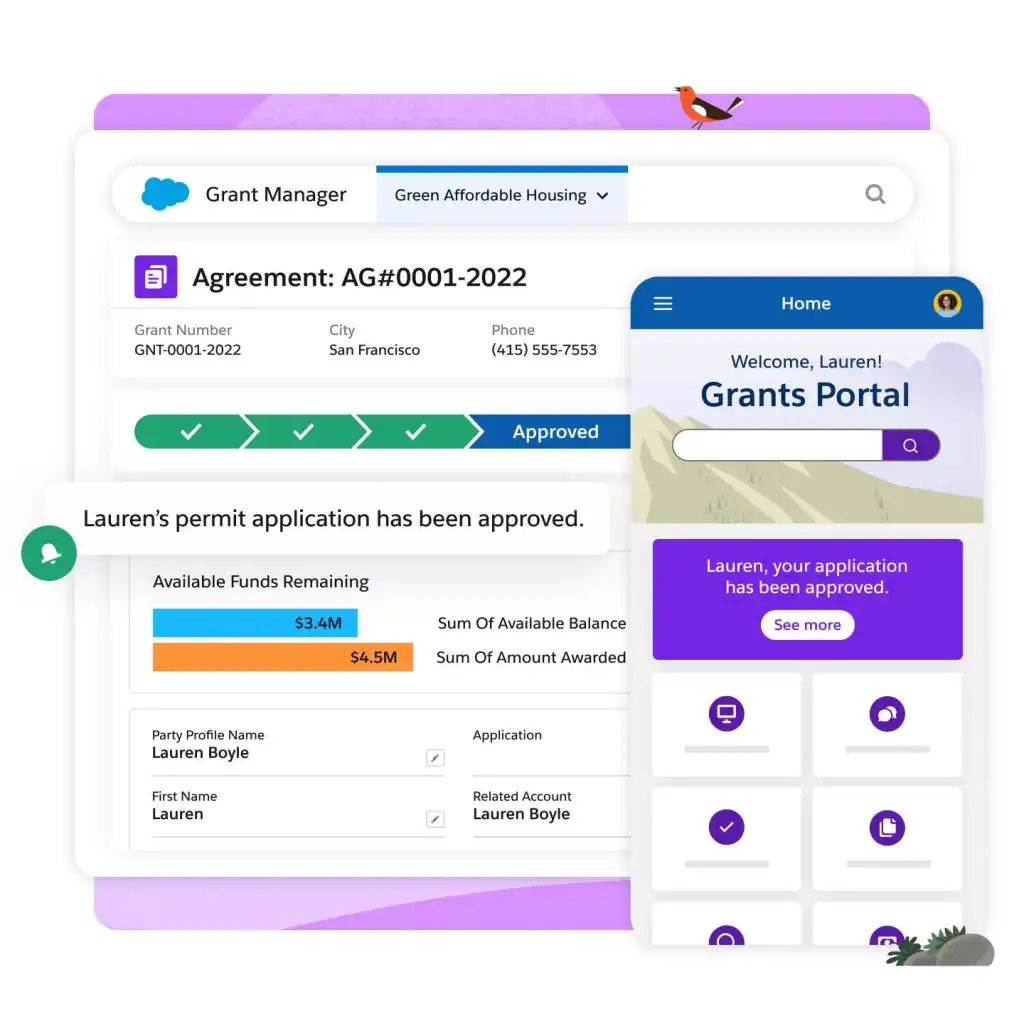
Source: https://www.salesforce.com/government/guided-tours/grants-management/
Picture a county distributing federal recovery funds to local nonprofits. Applicants apply and upload documents through a portal instead of email. Reviewers score applications in the same system, awards become tracked payments, and recipients submit progress reports through the same portal. When the federal report is due, the numbers are already in one place.
AI is starting to show up here too. Agents can check applications for missing information and handle a first round of scoring. One rule we hold firm on is that a person makes the final call on any rejection. A resident should never be told “the system denied your application” without clear, explainable reasons behind it.
Managing more than one funding stream? Our Public Sector Pulse webinar covers how state and local agencies are planning their Salesforce roadmaps, or you can speak with our team about your grants process.
Public Safety and Cross-Department Coordination
Severe storms, water main breaks, and large public events all pull multiple departments into the same situation at once. Emergency management, police, fire, public works, and public health need the same information at the same time. Salesforce public safety coordination gives them a shared view of incidents, shelter capacity, road closures, and where crews and equipment are deployed.
When a storm knocks out power across part of a county, public works, police, and emergency management can update one shared incident record instead of trading phone calls and spreadsheets. Residents can sign up for alerts on the neighborhoods and topics they care about, so a boil-water notice reaches only the households it affects. After the event, the same record shows what happened, who responded, and how long it took, which helps with after-action reviews and disaster reimbursement paperwork.
Sharing sensitive information safely depends on role-based permissions, meaning each user sees only what their job requires. A public works supervisor might see a road closure but not the police report behind it. Some data carries extra rules. Criminal justice information, for example, falls under federal CJIS security requirements, so plan for it early.
Secure Integrations for Local Government Systems
Modernizing doesn’t mean replacing everything. Most agencies have real investments in mapping software (GIS), financial systems, property tax databases, and court records. An integration connects those systems to Salesforce so data moves automatically. It typically runs through an API, a standard way for one system to request or send data to another.
Salesforce for municipalities and Salesforce for counties works best as the layer that ties these systems together. A permit can pull parcel data from GIS. A paid fee can post to the finance system. A service request can show a property’s past requests and permits. Vectr’s integration architecture work focuses on making these connections hold up when one of the underlying systems is upgraded.
Agencies with many systems to connect can go further with MuleSoft, which makes integrations reusable across projects, as we explained in our post on the MuleSoft shift.
Data governance matters here too. It’s the set of rules for who owns data, who can access it, and how long it’s kept, and it applies at every level of government. Your platform should follow your state’s public records laws and retention schedules. Some agencies will also need Salesforce Government Cloud, a separate environment built to meet U.S. government security standards like FedRAMP. Whether you need it depends on your data and your funding requirements. Our guide to FedRAMP vs. CMMC explains the difference.
How Vectr Solutions Supports Local Government Salesforce Implementations
Vectr Solutions’ delivery model is led by Salesforce architects. The people who design your system stay involved through the build. We start with the foundation: cleaning up data and mapping how information should flow before anyone buys licenses or builds screens. Skip that step, and a new platform just gives you the same old problems at a higher price.
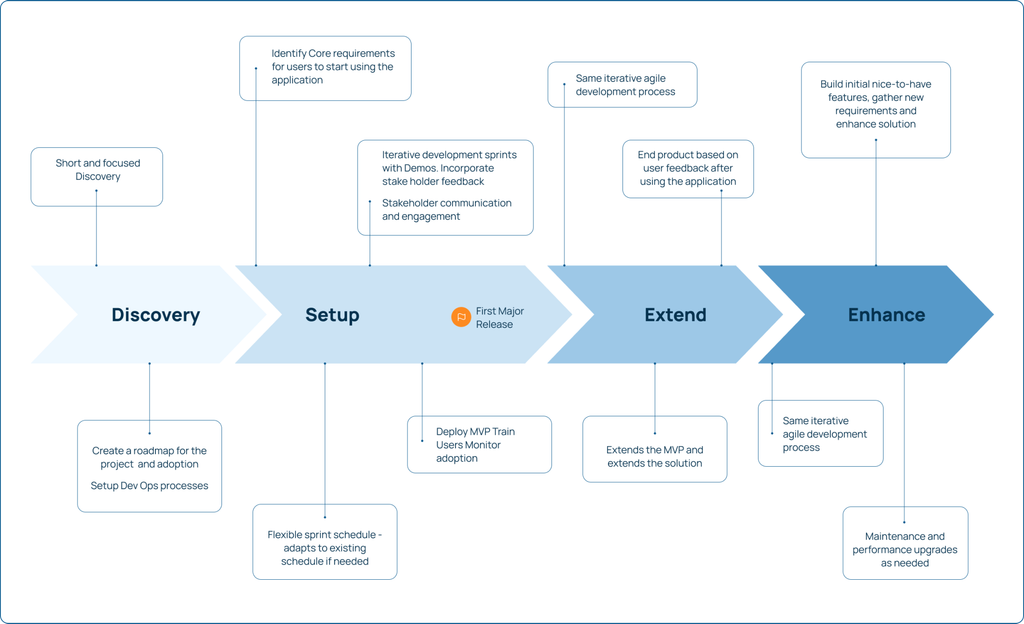
For cities and counties, that work usually comes together in stages. Advisory and governance helps you decide where to start and builds a phased roadmap that fits your budget cycle. Implementation delivers the first department’s solution, often service requests, permitting, or grants. Integration architecture connects Salesforce to the systems you keep. Our Parks and Rec Volunteer Management and Wildlife and Licensing accelerators give field-heavy departments a working starting point. Local IT teams are often small, so we design solutions your staff can maintain and change on their own, and our managed services team can stay on after go-live if you want continued support.
Technology only works if people use it. We use Prosci change management, a research-based method for the people side of a new system. It covers who needs to know what, when they need to know it, and how to keep new habits from slipping, so the clerk, the inspector, and the crew lead all work the same way in the new system.
Our public sector experience includes case management for a statewide child support program, a 911 integration for a state wildlife agency, and volunteer management for a state litter-prevention commission. City and county teams run on the same building blocks at a smaller scale, and we size each project to match.
Ready to Modernize How Your Agency Serves Constituents?
From permitting to grants to public safety coordination, local government agencies are replacing disconnected processes with a single platform. Vectr Solutions can help you scope what that looks like for your organization.