

Organizations are moving quickly to evaluate Agentforce, but many are approaching it the same way they approached chatbots, workflow automation, or previous AI initiatives. As consultants and solution architects, we’re seeing a different reality emerge.
The organizations finding success with Agentforce are not necessarily the ones building the most agents. They’re the ones investing in the right foundations first.
In our experience, the first 90 days of an Agentforce initiative have very little to do with prompt engineering and everything to do with data readiness, governance, security, and operational ownership. The decisions made during this early phase often determine whether Agentforce becomes a trusted business capability or another pilot that struggles to scale.
Here are seven mistakes we consistently see organizations make when getting started.
Mistake #1: Treating Agentforce Like a Better Chatbot
One of the most common misconceptions is viewing Agentforce as the next generation of chatbot technology.
Traditional bots are designed to guide users through predefined paths. Agentforce is designed to reason through tasks, gather context, make decisions within established guardrails, and take action across business systems.
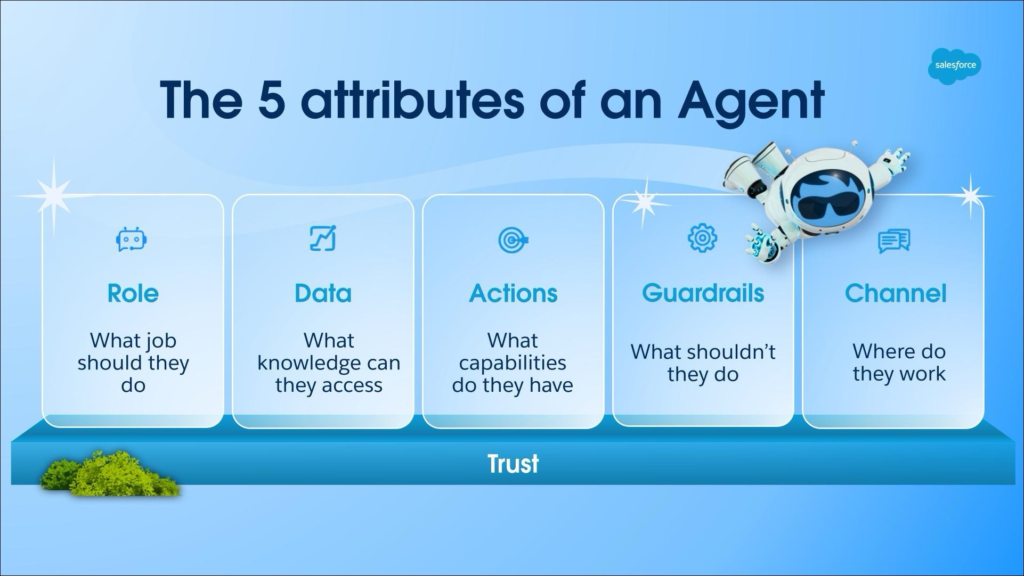
Source: https://admin.salesforce.com/blog/2025/build-secure-and-compliant-ai-agents-automate-with-agentforce
The difference matters because it changes how organizations should design solutions. Teams focused solely on conversation design often miss the broader opportunity to streamline business processes, reduce administrative effort, and automate work that previously required human intervention.
Designing for conversations is a trap. The organizations achieving the highest ROI are those designing around tangible business objectives.
Mistake #2: Starting with the Agent Instead of the Data
Nearly every unsuccessful AI initiative shares one common trait: poor data quality.
Organizations frequently become excited about what the agent can do before evaluating whether the information behind it is complete, accurate, and accessible. The result isn’t simply inaccurate responses. It creates operational risk, erodes user trust, and limits adoption.
In our experience, successful Agentforce deployments begin with a thorough data assessment. Teams need to understand where critical information resides, how current it is, who owns it, and how it will be surfaced to the agent. Crucially, this assessment should also evaluate data quality and identify potential bias. If the underlying data is flawed or biased, the agent will simply automate and repeat those errors.
This is particularly important for organizations operating across multiple systems, including ERP platforms, data warehouses, custom applications, and legacy databases. Agentforce performs best when users can access trusted context regardless of where that information originates.
Ultimately, success requires a fundamental shift in technical priority. Organizations must look past prompt engineering and solve for context engineering.
Mistake #3: Automating High-Risk Processes Too Early
Many organizations immediately gravitate toward complex use cases involving approvals, financial transactions, customer commitments, or sensitive data.
While these use cases may ultimately deliver significant value, they are rarely the best place to start.
We’ve consistently seen more success when organizations begin with lower-risk operational processes where outcomes can be measured, refined, and expanded over time. Examples might include knowledge retrieval, internal support requests, account research, meeting preparation, or case summarization.
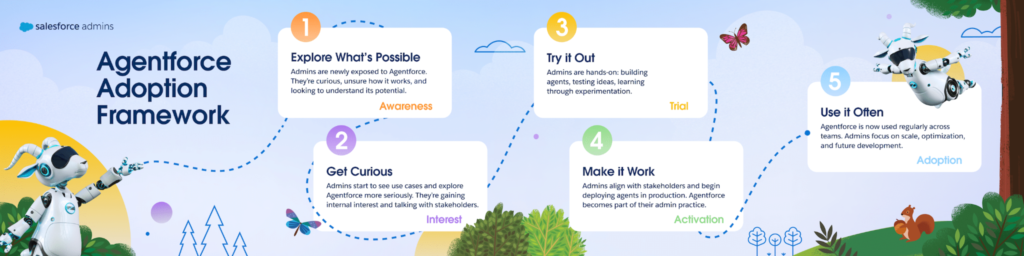
Source: https://admin.salesforce.com/blog/2025/your-guide-to-successful-agentforce-adoption
Early wins build confidence. Confidence builds adoption. Adoption creates the momentum required for larger transformations. Trying to automate everything on day one often creates resistance instead.
Mistake #4: Operating Without Clear Ownership and Governance
Agentforce is not a feature that can simply be enabled and forgotten. Every agent requires ongoing oversight, monitoring, optimization, and business ownership. Yet many organizations struggle to answer a simple question:
Who owns the agent?
When ownership is unclear, responsibility becomes fragmented. Business teams assume IT is managing the agent. IT assumes the business is responsible for outcomes. Meanwhile, no one is actively measuring performance or improving the experience.
We recommend establishing governance early, including executive sponsorship, operational ownership, change management processes, and a framework for evaluating future use cases.
The most successful organizations treat agents not as IT projects with a defined end date, but as dynamic digital assistants that require continuous coaching, evaluation, and optimization.
Mistake #5: Underestimating Security and Access Design
As AI capabilities expand, security architecture becomes increasingly important.
One of the most common technical mistakes we encounter is over-permissioning. Teams become focused on making the agent work and inadvertently grant access beyond what is actually required.
The principle of least privilege should remain foundational.
Agents should only access the data, systems, and actions necessary to perform their intended function. Organizations operating in regulated environments should also ensure they have appropriate monitoring, auditing, and reporting mechanisms in place to maintain visibility into agent behavior.
Trust is difficult to earn and easy to lose. Security design plays a significant role in maintaining that trust.
Mistake #6: Attempting a Large-Scale Rollout Too Quickly
Organizations often feel pressure to demonstrate immediate value from AI investments. Unfortunately, this pressure can lead to overly aggressive deployment strategies. The most effective implementations we’ve seen follow a phased approach:
- Phase One focuses on architecture, data readiness, and governance.
- Phase Two focuses on configuration, testing, and validation.
- Phase Three introduces a controlled pilot with a limited audience and clearly defined success criteria.
This approach allows organizations to learn, adapt, and improve before introducing Agentforce at scale. The goal is to realize measurable business value early on through a foundation that allows that value to scale long term.
Mistake #7: Measuring Activity Instead of Business Outcomes
One of the easiest traps to fall into is focusing on metrics that are easy to report rather than metrics that matter.
Conversation volume, agent usage, and interaction counts may demonstrate adoption, but they rarely demonstrate value.
Instead, organizations should align measurements to business outcomes.
- Has case resolution time improved?
- Have employees reduced time spent on administrative work?
- Are support teams handling more requests without increasing headcount?
- Is customer satisfaction improving?
The strongest Agentforce programs establish outcome-based KPIs before deployment begins and measure success against those objectives throughout the lifecycle of the initiative.
How to Set Up Agentforce for Long-Term Success
The organizations achieving the greatest value from Agentforce are not treating it as a standalone AI project.
They’re treating it as a business transformation initiative.

That means investing in data quality, integration strategy, governance, security, and change management before scaling automation. It means prioritizing business outcomes over technical novelty. Most importantly, it means recognizing that success is determined less by the agent itself and more by the operational foundation supporting it.
Agentforce has the potential to fundamentally change how organizations work. The companies that realize that value will be the ones that focus on building the right foundation first.
How Vectr Solutions Helps Organizations Build for Scale
At Vectr Solutions, we help organizations move beyond AI experimentation and build practical, scalable Agentforce strategies. Our team works alongside business leaders, architects, and administrators to establish the governance, security, integration, and data foundations required for long-term success.
Whether supporting commercial enterprises, government agencies, or highly regulated organizations, our focus remains the same: delivering solutions that create measurable business value while positioning teams to operate confidently as AI capabilities continue to evolve.