

Key Takeaways
- Agentforce, Slackforce, and Claudeforce aren’t three separate products competing for the same job. They’re three different front doors into the same underlying system, and each fits certain situations better than others.
- The right starting point depends more on what your organization already has in place, like GovSlack adoption or existing licensing, than on which announcement generated the most buzz at Dreamforce.
- Wherever you start, Agent Fabric sits above all three as the governance layer, so the front door choice shouldn’t be treated as a permanent architectural commitment.
- Vectr Solutions helps organizations map this decision to their actual environment before a build starts, based on the same framework we use for every Agentforce roadmap engagement.
If you’re planning an Agentforce project this fall, you’ve probably run into a version of this question: where should this actually live? Native Agentforce inside Salesforce, Agentforce in Slack through Slackforce, or Salesforce in Claude through Claudeforce?
It’s tempting to treat this like picking a winner, but that framing leads teams astray. The better question is which front door fits which piece of work, and where your organization should build its habits first.
Native Agentforce, Slackforce, and Claudeforce: Three Doors, One System
It helps to name all three options plainly before comparing them.
Native
Interface: Salesforce
Native
Build and run agents directly inside Salesforce, where the interface is Salesforce itself, whether that’s a record page, a flow, or Agentforce’s own chat window.
Slackforce
Interface: Slack
Slackforce
Slack becomes the place people ask questions and see results, with Slackbot pulling live views of Salesforce data directly into a conversation.
Claudeforce
Interface: Claude
Claudeforce
Claude either reasons behind an Agentforce agent or, through the newer Salesforce in Claude plugin, brings Salesforce data into a conversation happening inside Claude itself.
None of these is a wrapper around the others. Each is a genuinely different way for a person to reach the same underlying data and the same agent capabilities. For a side-by-side look at what each one includes, see our breakdown of Claudeforce vs. Slackforce vs. Agentforce Coworker.
Why This Isn’t Really a Competition
The instinct to rank these three, deciding which one is “best,” misses how they actually work together.
An agent built natively in Salesforce can still use Claude as its reasoning model. A Slackforce Surface can display information that an agent updated through a completely different path.
The three sit at different points in the same system rather than competing for the same job, which means the real decision isn’t “which one wins” but “which one should our organization get comfortable with first, and for which kinds of work.” It’s the same idea behind running Salesforce as a headless CRM.
How to Choose: Start With What You Already Have
The most practical way to answer that is to look at what’s already true about your organization rather than starting from a blank slate. An agency already running GovSlack, with most of the staff living in Slack for daily communication, has a real head start with Slackforce, since adoption doesn’t require teaching people a new habit, only a new capability inside a tool they already open every morning. We’ve seen this firsthand in how SLED agencies use Slack and Salesforce to coordinate cases.
An organization that hasn’t adopted Slack at all, or one where compliance concerns make adding a new interface a heavier lift than it’s worth, is often better served staying native inside Salesforce, keeping the agent close to the data and the existing security model instead of introducing a new surface to govern.
And for organizations with a Claude Enterprise contract already in place, or a team that already leans on Claude for research and drafting throughout the day, Claudeforce’s Salesforce in Claude direction can meet people where they’re already working, though it’s worth remembering that path is still in pilot and expanding rather than fully mature.
Weighing the Type of Work, Not Just the Tool
Existing habits matter, but so does the shape of the work itself.
For example
A case management workflow that checks eligibility and updates a record.
A manager trying to understand why a queue backed up this week.
Where it belongs
Close to the system of record, native inside Salesforce or Agentforce, where every step logs cleanly and doesn’t depend on a person remembering to ask the right question in the right channel.
Wherever the conversation is already happening, which points toward Slackforce or Claudeforce depending on which tool that team actually lives in.
- Native
- Slackforce
- Claudeforce
The workflow itself is usually a better guide than a preference for one interface over another.
Agent Fabric Governance Doesn’t Care Which Door You Picked
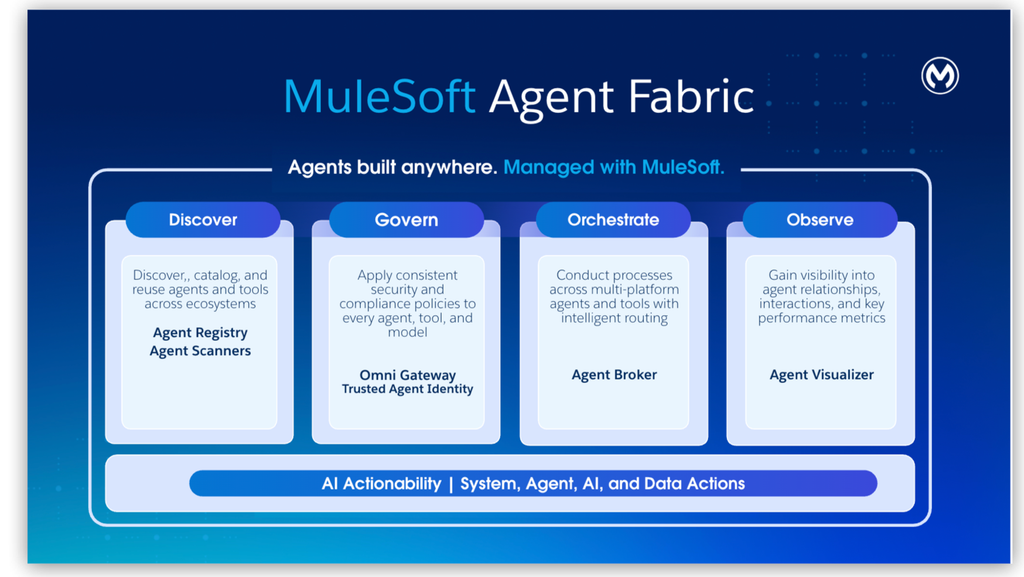
Wherever an agent ends up, Agent Fabric is the layer tracking what it did, which model reasoned through it, and what it was allowed to touch.
Source: https://docs.mulesoft.com/general/agent-fabric-overview
We wrote about Agent Fabric’s role in the broader platform back in June, and the point worth repeating here is that governance sits above the front door decision rather than depending on it. That’s good news for anyone worried about picking wrong. A front door choice that turns out to be a poor fit six months in doesn’t mean starting over, because the underlying governance, permissions, and data model don’t change when the interface does. That’s a much lower-stakes decision than it might feel like at the outset.
How We Map the Front Door Decision With Clients
This is the same mapping exercise behind the Dreamforce session we presented this year on moving from AI pilots to operational Agentforce, and it’s the starting point for nearly every Agentforce engagement we run.
Before opening Agent Builder, we look at what tools a client’s staff already use daily, what kind of work the first agent needs to handle, and what a security or compliance review will expect to see once it’s live. That groundwork shaped how we approached a recent rapid Salesforce expansion for a public sector client, where the interface decision had to hold up under both a tight timeline and a compliance review, not just work well in a first demo.
Choosing a Salesforce Front Door: FAQ
Should we build Agentforce agents in Salesforce, Slack, or Claude?
Start with where your people already work and what kind of work the agent handles. Structured, auditable processes usually belong native in Salesforce. Conversational, exploratory work fits Slack or Claude, depending on which tool your team already lives in.
What is Salesforce in Claude?
Salesforce in Claude is the Claudeforce plugin that brings Salesforce data into conversations inside Claude. It’s still in pilot and expanding, so it’s best suited to teams that already use Claude every day.
Is the front door decision permanent?
No. Agent Fabric governs agents above the interface, so permissions, governance, and the data model stay the same if you change front doors later.
Figuring Out Your Starting Point
If your team is trying to decide where a specific Agentforce initiative should live, that’s a conversation worth having before any building starts. Reach out to Vectr Solutions, and we’ll help you map your environment, your team’s habits, and your compliance requirements to the front door that actually fits, rather than the one that got the most attention at Dreamforce.