
Picture a routine case moving through a state agency. It starts in one system, gets summarized in an email, forwarded to another department, re-explained on a phone call, and finally lands in a spreadsheet someone updates by hand every Friday. By the time a decision gets made, the case has been retold four different times by four different people, and no one is fully sure which version is current. This is not a hypothetical. It is Tuesday for a lot of SLED case managers.
That gap between where case data lives and where the actual conversation happens is the quiet tax on public service delivery. A Slack Salesforce integration for government closes it, connecting the system of record to the place where staff already talk, decide, and collaborate.
The Challenge of Case Coordination in SLED Agencies
Most SLED agencies aren’t short on data. They’re short on a shared, real-time view of it. Case information lives across standalone applications, siloed by department and, often, by decade. One team runs on a legacy case management tool, another lives in email, and a third is still working off a shared drive that someone’s supposed to reorganize “soon.”
That fragmentation shows up as slower response times, duplicated work, and staff who spend more time chasing status updates than resolving cases. For public safety, social services, and education administrators, the cost isn’t abstract. It’s a family waiting longer for a benefits decision, a student support case that stalls between departments, or a public safety response that loses precious minutes to a communication handoff.
Why Slack + Salesforce Is a Powerful Combination
Salesforce is built to be the system of record: structured case data, constituent profiles, audit history, the whole operational backbone. Slack is built to be the real-time layer where people actually get things done: quick questions, fast decisions, cross-team huddles.
Connect the two, and case data stops living in a database that people have to go looking for. It shows up inside the conversation. Instead of switching between five tabs and an inbox, a caseworker can search, view, and update a live Salesforce record without leaving Slack. That’s not a minor convenience. It’s the difference between information sitting in a system and information moving with the work.
How Slack + Salesforce Streamline Case Coordination
The old model for a complex case looks like a relay race with a lot of dropped batons: a ticket gets submitted, passed from agent to agent, and re-explained at every handoff. Context gets lost. Citizens feel it.
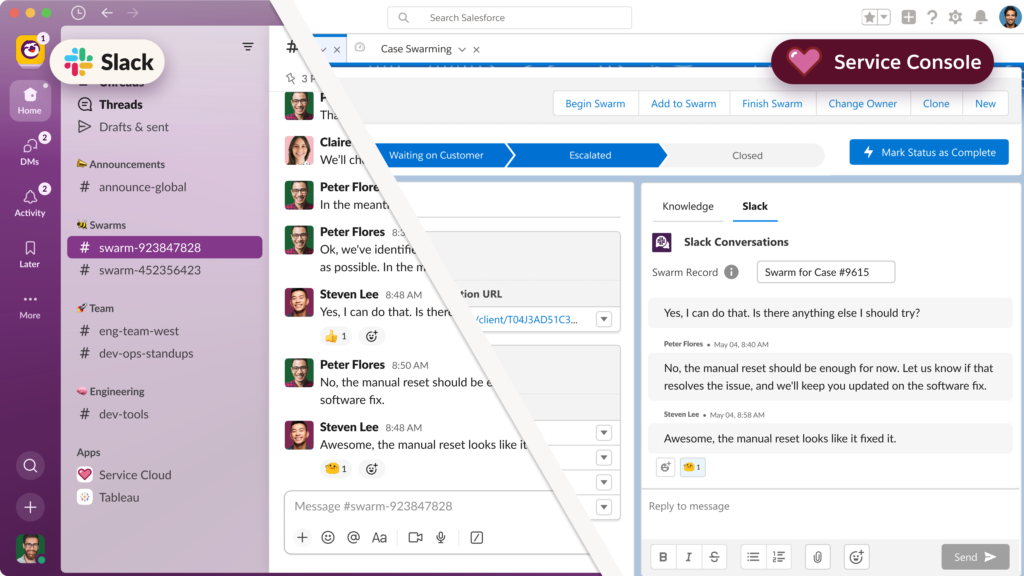
Source: https://slack.com/blog/transformation/discover-salesforces-recipe-for-customer-success
An integrated Slack-Salesforce workflow replaces that with something closer to “intelligent swarming.” One case manager owns the case from start to finish. When something complex comes up, they trigger a swarm request directly in Salesforce, which automatically spins up a dedicated, secure Slack channel and pulls in the right cross-functional experts based on skill and availability. No manual routing, no game of email tag. Because the people who need to talk are already in the room, fewer cases stall between handoffs.
Key Use Cases for SLED Agencies
This isn’t theoretical. Vectr Solutions has watched this play out with real caseloads and real deadlines.
Social services: In partnership with a government services company, we supported the modernization of Kansas’s child support case management program, consolidating case data that had been scattered across disconnected external sources and automating task routing for more than 70,000 cases a year across 50-plus caseworkers. The result: average case task resolution time dropped from 90 days to 30, the average age of open case tasks was cut in half, and caseworkers were closing roughly 20,000 tasks a month. That’s not a marginal efficiency gain, that’s families getting answers roughly three times faster.
Mission-critical government operations: On a defense-focused case management deployment, we built standardized routing and SLA tracking alongside branded self-service portals, giving sponsors real-time visibility instead of status-check phone calls, all inside a FedRAMP-compliant GovCloud environment, live in ten weeks.
Public safety: Automated alerts routed directly into responder channels give multiple departments shared situational awareness the moment an incident is logged, instead of relying on radio traffic and follow-up calls.
Education administration: Financial aid cases, facility requests, and student support workflows move faster when academic and administrative staff are collaborating in the same channel a case is being tracked in, rather than trading emails about it.
Workflow Automation and Efficiency Gains
Low-code tools (Salesforce Flow on one side, Slack’s Workflow Builder on the other) let agencies build trigger-based notifications without a developer backlog. A new case creates itself, alerts the right team in Slack with the details that matter, and lets staff log notes or close it out without touching a separate database. Less swivel-chair data entry, more time on the actual mission. And because the conversation happens on the record, the audit trail writes itself.
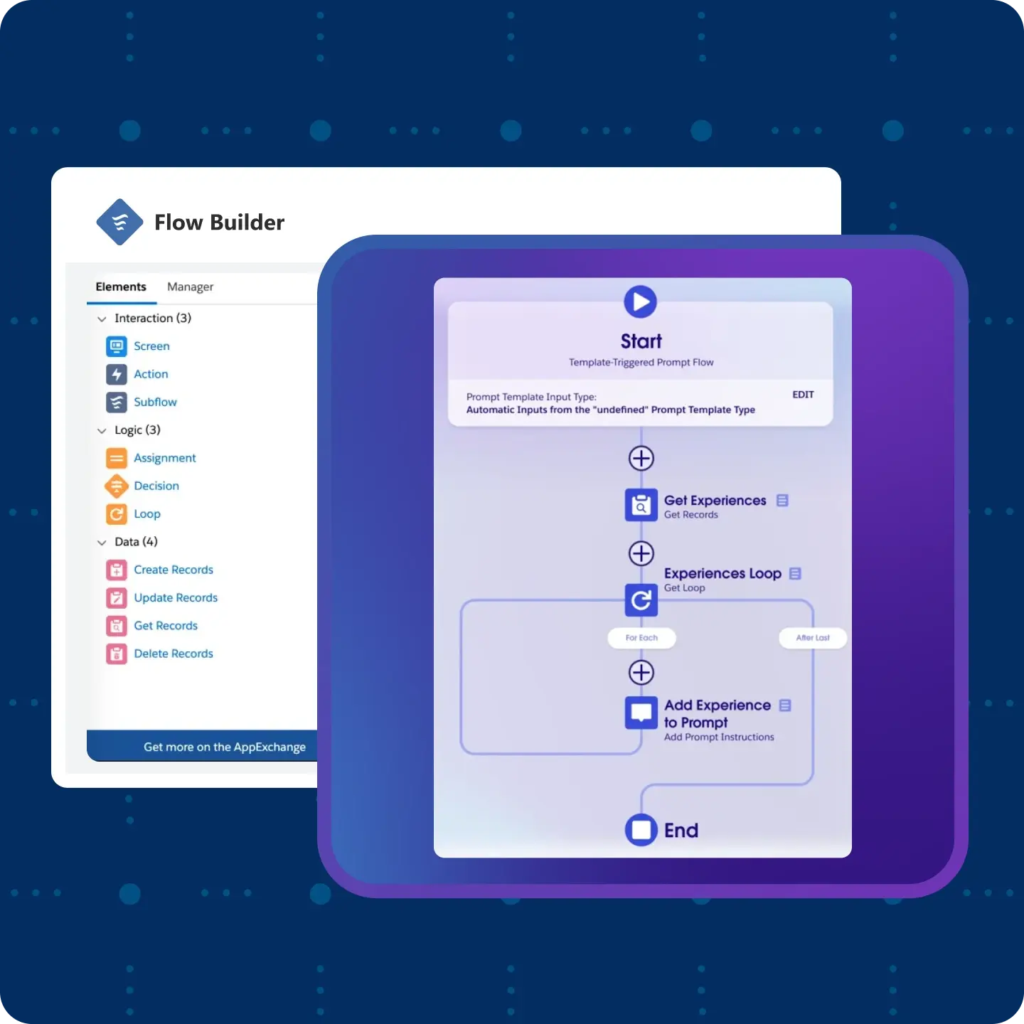
Source: https://www.salesforce.com/mulesoft/automation/
Security and Compliance Considerations
None of this works if it compromises data protection, and SLED agencies don’t get to treat compliance as optional. That’s where GovSlack comes in being a dedicated Slack instance built specifically for federal, state, and local governments and their contractors, running in AWS GovCloud and maintained by screened U.S. citizens. Paired with Salesforce Government Cloud Plus, it meets FedRAMP High and FIPS encryption standards while still functioning like the Slack your team already knows how to use. If your agency is weighing a move from commercial Slack, our migration guide walks through what actually changes.
Implementation Considerations for Agencies
Getting this right starts with an honest look at your current systems: where the silos actually are, which workflows are worth automating first, and where staff will need support adjusting to a new way of working. Integration planning, change management, and training aren’t afterthought, they’re what separates a tool that gets adopted from one that gets ignored six months in.
Why Work with Vectr Solutions
Designing a secure, compliant Slack-Salesforce integration that actually fits how your agency operates takes more than a generic playbook. Vectr Solutions brings deep experience across SLED and federal environments, from Salesforce Government Cloud implementations to GovSlack rollouts, with a track record of measurable outcomes, not just deployed software.
- Proven integration experience across public sector case management
- Government-focused solutions built for FedRAMP and compliance realities from day one
- Scalable, secure implementations that don’t create technical debt down the road
- Ongoing support to keep the system improving after go-live
Streamline Case Coordination with the Right Technology
Vectr Solutions helps SLED agencies integrate Slack and Salesforce to improve communication, automate workflows, and enhance case coordination. Our team delivers tailored solutions built for the realities of government operations and long-term success.